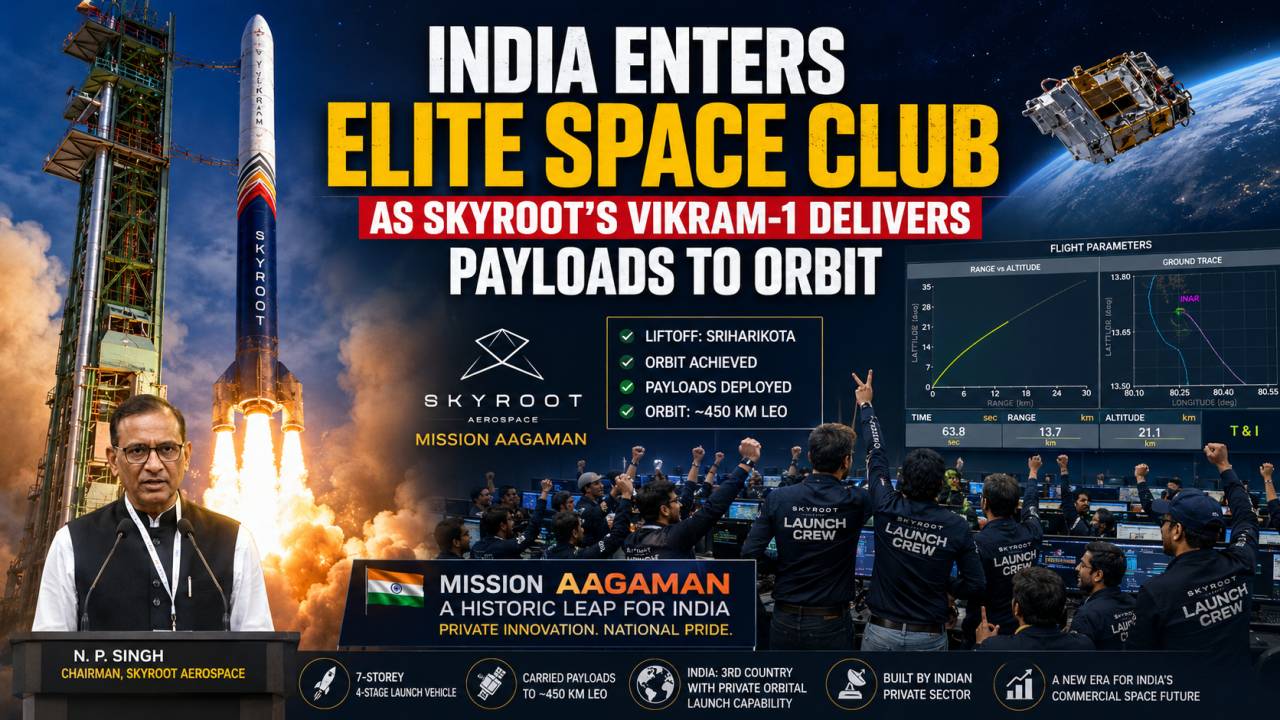
Sriharikota, July 18 : India’s private space sector crossed its biggest milestone yet on Saturday as Skyroot Aerospace’s Vikram-1 rocket reached orbit on its very first test flight and successfully deployed its payloads. With the mission, India joins the United States and China as only the third country where a privately built rocket has independently achieved orbital launch capability.
The flight, designated Mission Aagaman, lifted off from the First Launch Pad at ISRO’s Satish Dhawan Space Centre in Sriharikota, Andhra Pradesh. Prime Minister Narendra Modi congratulated the Skyroot team on the achievement, calling attention to what the mission means for the country’s growing commercial space ambitions.
A Seven-Storey Rocket Built For Small Satellites
Vikram-1, named in honour of Dr Vikram Sarabhai, the founding father of India’s space programme, is a four-stage launch vehicle standing roughly seven storeys tall. It has been designed for quick-turnaround, on-demand launches of small satellites, and on this flight carried its payloads to a Low Earth Orbit around 450 km above the planet.
The Hyderabad-based startup has described its long-term vision as building a “cab service to space” — a model where customers can book dedicated launches and have their satellites placed into precise orbits faster, more flexibly, and at lower cost than traditional rideshare options.
Skyroot tracked the launch live on X, confirming lift-off from Sriharikota and, ten seconds into the flight, a clean clearance of the launch tower — the first of a series of milestones the vehicle ticked off on its way to orbit.
From Prarambh To Aagaman
This is Skyroot’s second trip to space. In November 2022, the company’s Vikram-S suborbital rocket flew under Mission Prarambh, becoming the first privately developed Indian rocket to cross into space and effectively opening the door for the country’s private launch ecosystem.
Saturday’s orbital success goes several steps further. Reaching orbit — and deploying payloads once there — validates the full launch vehicle stack, from propulsion and staging to guidance and separation systems. For India’s space economy, that translates into a credible homegrown commercial launch option at a time when global demand for small-satellite launches is climbing sharply.
Industry watchers see the mission as a turning point that strengthens India’s position in the global commercial launch market and signals that the reforms opening the space sector to private players are beginning to deliver flagship results.