SMSS SIR Sikkim has emerged as a key issue after Sikkimese Moolniwasi Suraksha Sangh president Ratna Lal Sapkota said the organisation has neither won nor lost its Supreme Court case concerning the Special Intensive Revision (SIR) of electoral rolls in the state. He also reiterated the organisation’s demand for an earlier cut-off date for the revision exercise.
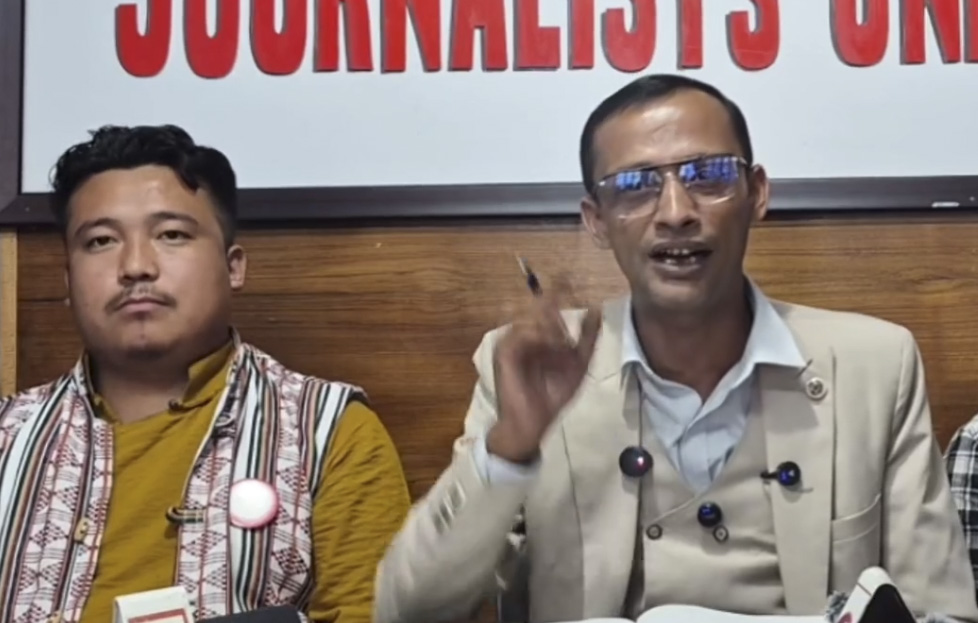
Gangtok, Sep 3: Sikkimese Moolniwasi Suraksha Sangh (SMSS) president Ratna Lal Sapkota has said that the organisation has neither won nor lost its case before the Supreme Court concerning the Special Intensive Revision (SIR) of electoral rolls in Sikkim, while reiterating its demand for an earlier cut-off date for the revision exercise.
Addressing a press conference, Sapkota said the organisation supports the SIR process in principle and had, in fact, been demanding such an exercise in Sikkim for several years. However, he said the SMSS objected to 2002 being used as the reference year and had sought an earlier legally acceptable date.
“Our opposition was never to SIR itself. We welcomed the process, but wanted the base year to be taken further back,” Sapkota said.
According to him, the organisation had earlier moved the High Court through a Public Interest Litigation before approaching the Supreme Court. He said the matter was heard before the apex court on August 17.
Sapkota rejected claims that the SMSS had lost the case.
“We have neither won nor lost the case. It is incorrect to say that the SMSS went to the Supreme Court and lost,” he said, adding that the organisation’s principal demand was for the 2002 reference year to be reconsidered.
He said the SMSS had suggested 1993 as one possible cut-off year, while also remaining open to earlier dates such as 1990, 1989, 1979 or 1974 if considered legally appropriate.
Explaining the preference for 1993, Sapkota said several legal and administrative frameworks concerning Sikkim had already been established by then. However, he clarified that the organisation was not insisting that 1993 must necessarily be adopted.
“The important point is that the date should be legally appropriate and earlier than 2002,” he said.
Sapkota also said the organisation’s lawyers had raised concerns before the Supreme Court regarding migration and demographic changes in border states.
He maintained that the SMSS had lost nothing by approaching the courts because the existing 2002 reference year remained unchanged, while the organisation had gained additional avenues to pursue the matter before different authorities.
According to Sapkota, representatives of the organisation have approached the Election Commission of India, the Ministry of Home Affairs, various government departments, the Law Department, the Sikkim Election Department and other relevant authorities.
He said letters, representations and emails had also been submitted to institutions capable of examining issues connected with the SIR exercise.
Sapkota further raised concerns over what he described as an unusually rapid increase in the number of voters in Sikkim over the years, questioning how electoral rolls had expanded despite declining birth rates.
He referred to voter figures from different election years and said the organisation wanted the pattern to be properly examined. The claims regarding the scale and causes of voter-list growth were presented by the SMSS during the briefing and were not independently substantiated at the press conference.
The SMSS president was also careful to clarify that the Supreme Court had not ruled that Sikkim had “illegal voters”.
“We are not saying that the Supreme Court has already declared that illegal voters exist in Sikkim. We are only presenting what we have placed before the authorities on the basis of documents available with us,” he said.
Sapkota claimed the organisation had come across cases where individuals allegedly appeared to have electoral or welfare-related links in more than one country.
He cited hypothetical and documented instances involving people allegedly registered as voters in Sikkim while also having electoral links in countries such as Nepal or Bhutan, and cases where welfare benefits were allegedly being drawn from more than one jurisdiction.
The SMSS said such cases, if established through proper verification, should be examined by the competent authorities.
Sapkota stressed that genuine Indian citizens with valid documents should not lose their voting rights during the SIR process.
“If a person’s documents are genuine, that person’s vote should not be deleted. But if the documents are fraudulent or if a person is legally ineligible to be on the electoral roll, the name should be removed in accordance with law,” he said.
He also cautioned against allegedly creating false family relationships or using local residents to support fraudulent documentation.
According to Sapkota, the organisation has received written complaints alleging irregularities in documentation. He claimed that in at least one instance, a person had reportedly acknowledged an earlier mistake and sought cancellation of a document allegedly created through an improper process.
The SMSS president appealed to officials and members of the public not to exert pressure for the inclusion of ineligible names in electoral rolls.
He said the organisation had no personal hostility towards any individual or community and maintained that its objective was to ensure that the SIR process was completed fairly and successfully.
Sapkota further claimed that the SMSS had submitted complaints concerning 1,512 individuals whose electoral status it wants the authorities to verify.
He stressed, however, that it is for the Election Commission and other competent constitutional authorities — not the SMSS — to determine whether any name should be retained or deleted from the electoral roll.
“We do not delete anybody’s name. The competent authorities will decide, according to law, whether a name should remain or be removed,” he said.
Sapkota said the organisation would continue examining electoral records even after publication of the revised voter list and would approach the authorities again if it came across what it considered credible evidence of irregular inclusion.
He also appealed to genuine voters who may have been wrongly excluded during the revision process to come forward with supporting documents so that their cases could be taken up with the authorities.
Welcoming people from outside Sikkim who come to work, conduct business or earn a livelihood in the state, Sapkota said the SMSS had no objection to lawful residence or economic activity.
“Our concern is only that voting rights must be exercised where a person is legally entitled to exercise them,” he said.
He added that the SIR process was still underway and that the organisation would continue submitting representations and evidence to the Election Commission of India, the Ministry of Home Affairs and other relevant institutions whenever necessary.
I can also turn this into a stronger Rank Math SEO version with headline, focus keyword, permalink, meta description, tags, keywords and Facebook/YouTube post copy.