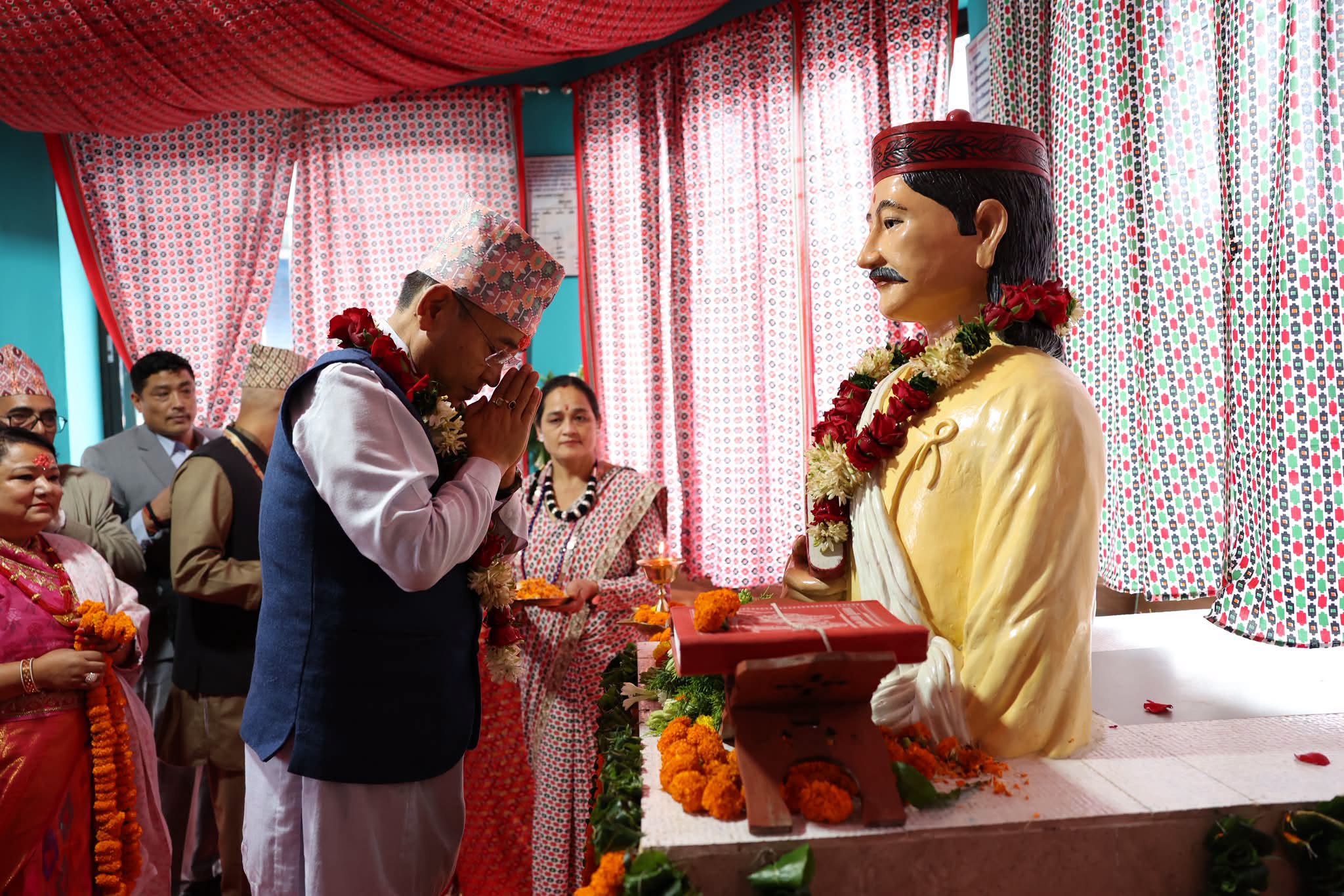

Soreng, July 13: Chief Minister Prem Singh Tamang Golay announced a new State award, the Anuvad Setu Puraskar, during the national-level celebration of the 212th Birth Anniversary of Adikavi Bhanu Bhakta Acharya held at Jautar, Soreng on Monday.
The award will honour translators who creatively bring internationally acclaimed literary works into the Nepali language. It carries a cash prize of Rs 3 lakh along with a citation and will be presented during Bhanu Jayanti celebrations whenever an exceptional translation is produced.
Speaking before a large gathering of literary figures, scholars, students and language enthusiasts, the Chief Minister said the award aims to build a bridge between the younger generation and world literature, while strengthening their emotional bond with their mother tongue.
The Chief Minister said the inspiration behind the award comes from Adikavi Bhanu Bhakta Acharya himself. The Adikavi did not simply translate the Ramayana into Nepali; he transformed it into the language of ordinary people and made literature and knowledge accessible to all. Great translations, the Chief Minister observed, have shaped the destiny of civilizations by democratising knowledge. The new award seeks to make global ideas, literature and philosophy available to Nepali readers without distancing them from their linguistic roots.
The announcement came as part of a wider address in which the Chief Minister laid out his Government’s approach to language and culture. He said genuine respect for a language is shown not merely through celebrations but through its place in governance, education and public life.
Paying tribute to former Chief Minister Late Nar Bahadur Bhandari, whom he described as the architect of modern Sikkim and a foremost champion of the Nepali language recognition movement, the Chief Minister acknowledged the sacrifices of countless language activists whose struggle secured constitutional recognition for Nepali. He noted that his Government has honoured this legacy by declaring 5 October as Nar Bahadur Bhandari Jayanti and 20 August as Nepali Bhasa Manyata Diwas, both official Government holidays.
The Chief Minister highlighted that Government notifications and Official Gazettes have been published in the Nepali language since August 2024, allowing Nepali to function not only as a language of literature but also as an instrument of administration.
He also listed initiatives aimed at strengthening the future of the language through education and research. These include the APATAN Fellowship, which provides financial assistance ranging from Rs 1 lakh to Rs 3 lakh to scholars pursuing doctoral studies in Nepali and other languages, the inclusion of Nepali in the Bachelor of Education curriculum, and the appointment of dedicated Nepali Primary Teachers, Graduate Teachers and Post Graduate Teachers.
The Chief Minister stressed that the advancement of Nepali and the preservation of Sikkim’s indigenous languages are complementary responsibilities, not competing ones. He pointed to the establishment of the Sikkim Board of Indigenous Languages, continued efforts to include Bhutia, Lepcha and Limboo in the Eighth Schedule of the Constitution, higher education opportunities in indigenous languages, multilingual publication of the Sikkim Herald, support for registered dance and music institutes, and assistance to Thangka artists and filmmakers.
Language, he said, is not a wall that divides communities but a bridge that connects them. Sikkim’s strength lies in its extraordinary diversity, where every language contributes to the collective identity of the State. In his vision of Sunawlo, Samriddha ani Samartha Sikkim, economic development must advance alongside cultural confidence, education, literature and self-respect.
Addressing the youth directly, the Chief Minister urged students to read at least one Nepali book every month. While recognising English as essential for engaging with the wider world, he said Nepali remains the language through which emotions, memories and identity are most deeply expressed.
The event at Jautar, Soreng carried a clear message: societies become truly prosperous not only through roads and economic growth, but through the strength of their languages, the vitality of their literature and the dignity of their people.