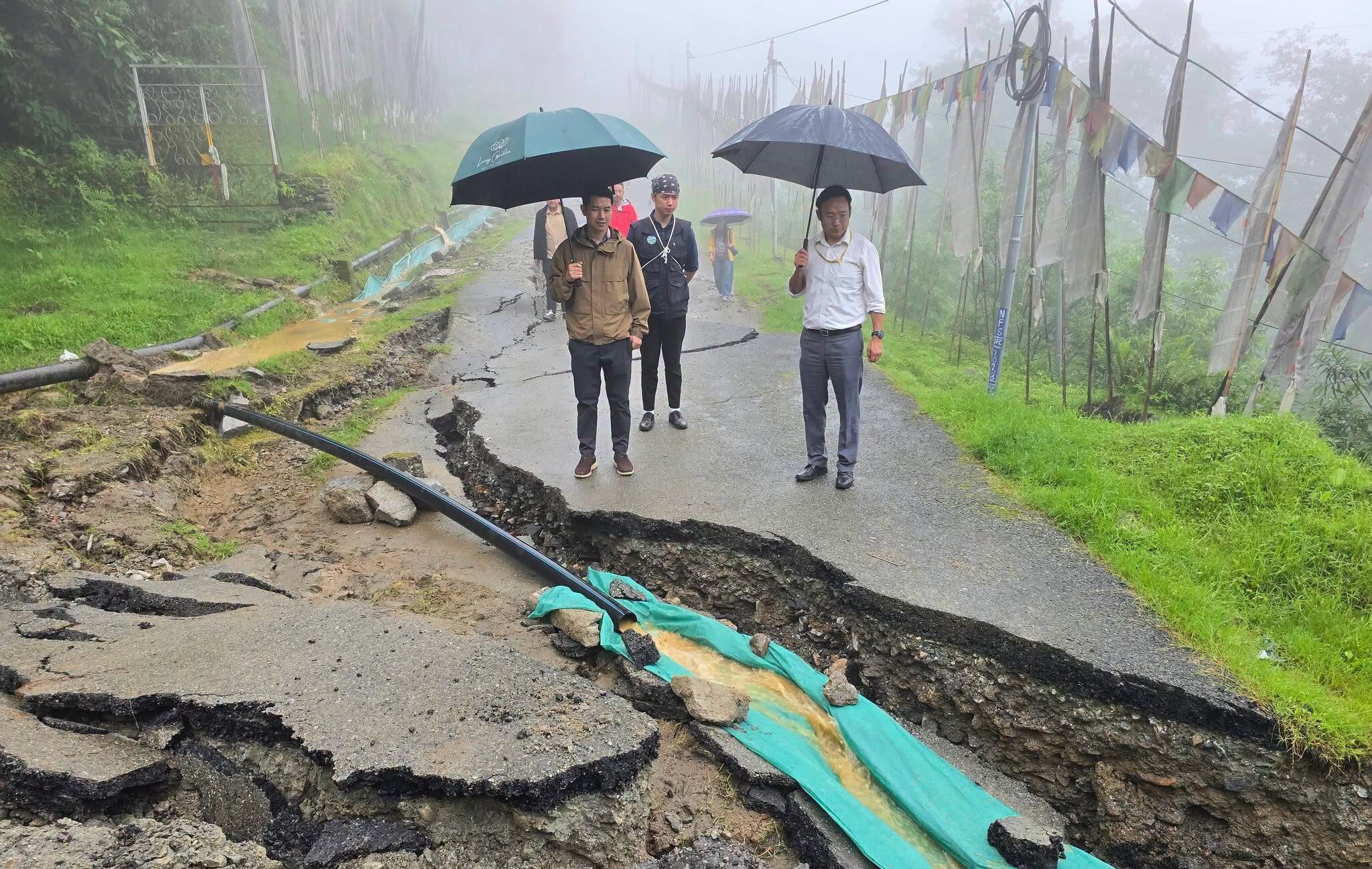
Kyongnosla Landslide Enters 11th Day: Strategic JN Road Section Destroyed, 32 Families Forced Out of Homes

Gangtok, July 18: A landslide that struck 7th Mile at Kyongnosla village eleven days ago is still active, and its toll is mounting — an entire stretch of the strategically vital Jawaharlal Nehru (JN) Road has been wiped out, and 32 families have been forced to leave their homes for temporary shelters.
The JN Road is no ordinary rural connection. It serves as a lifeline to the Indo–China border, linking several Indian Army establishments in the high-altitude frontier zone. With the slope refusing to settle, the old road alignment has been erased completely, and traffic has been pushed onto a single alternative route. Locals warn that this backup road itself sits on fragile monsoon-soaked terrain — one more slide, and the border corridor could be cut off entirely.
Families in Shelters, Hillside Still Moving
For the displaced households, the crisis is deeply personal. Having evacuated their homes as the hillside crept downward, the 32 families now live in makeshift accommodation with no clarity on when — or whether — they can return. The slope continues to show fresh movement, keeping the village on edge.
What has angered residents most, however, is the silence from the top. Eleven days into an active disaster, they say, not a single senior officer from the concerned departments or the district administration has come to inspect the damage or sit down with the affected families.
“Not a Priority”: GREF’s Reported Stand Draws Fire
The washed-away stretch falls under the General Reserve Engineer Force (GREF), the agency tasked with maintaining the road. Villagers say they have been told, informally, that rebuilding the destroyed section is not on the priority list — the reasoning being that the old alignment is no longer the main route and the alternative road is still functioning. A shortage of funds has reportedly been offered as a further justification for the delay.
Residents are unconvinced. Depending on a solitary access road in one of the most landslide-prone belts of the Himalaya, they argue, is a gamble no planner should take. Their question to the authorities is blunt: if the alternative route goes down in the next cloudburst, what is the fallback?
More Than a Local Problem
Beyond the hardship faced by Kyongnosla’s residents, the episode raises uncomfortable questions about the resilience of critical infrastructure in one of East Sikkim’s most sensitive corridors. Uninterrupted connectivity towards the border is not a luxury in this region — it is a strategic necessity, particularly during the monsoon months when weather disruptions are routine.
The affected families have appealed to both the Government of India and the Government of Sikkim for immediate intervention on four fronts:
- Restoration of the destroyed road section without further delay
- Relief and rehabilitation support for the displaced households
- Permanent slope stabilisation and long-term disaster mitigation works at the site
- A comprehensive vulnerability survey of the entire JN Road to identify and secure other high-risk stretches
With the mountain still shifting and no official response in sight, Kyongnosla waits — its residents displaced, its road broken, and a corridor of national importance hanging in the balance.
Report By Sheetal K