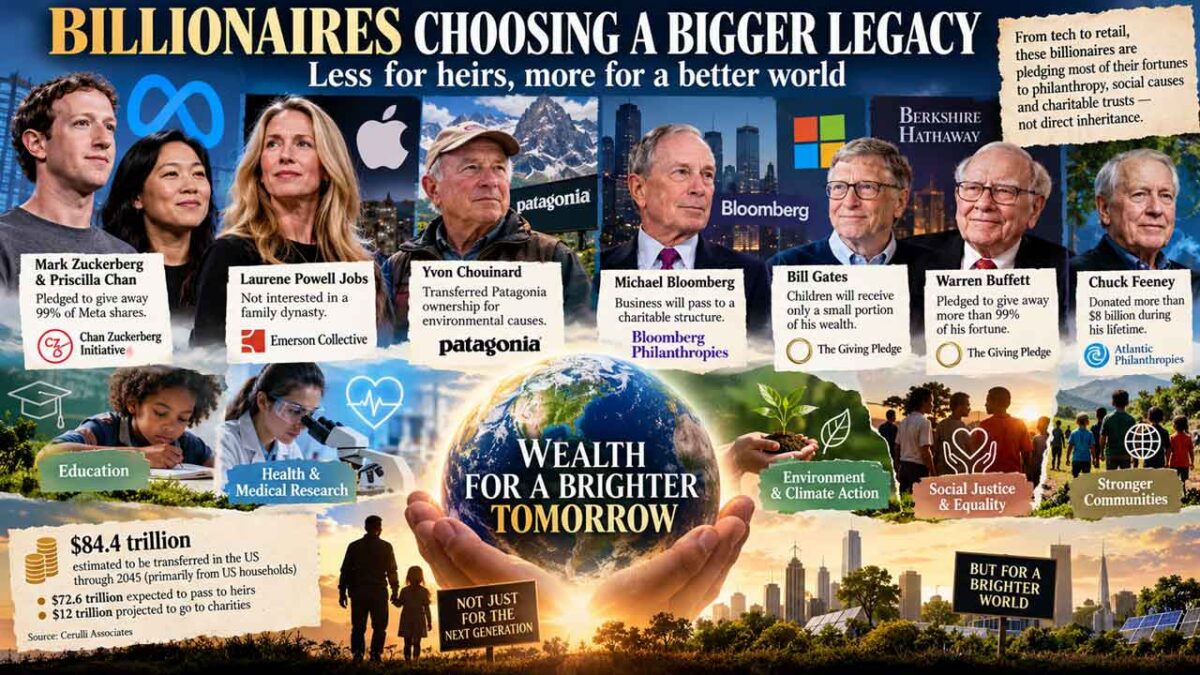
Gangtok, October 7 : Billionaires limiting family inheritances are reshaping the debate over inherited wealth by pledging to direct most of their fortunes towards philanthropy, social causes or charitable trusts rather than transferring the money directly to their children.
Mark Zuckerberg, Laurene Powell Jobs, Yvon Chouinard, Michael Bloomberg, Bill Gates and Warren Buffett are among the wealthy individuals who have publicly outlined plans to give away substantial portions of their assets. Their approaches differ, and the commitments do not necessarily mean their children will receive nothing.
Instead, the common principle is that extreme wealth should not automatically pass intact from one generation to the next. Some of these billionaires have promised to donate most of their holdings during their lifetimes, while others have created structures intended to distribute their wealth after death.
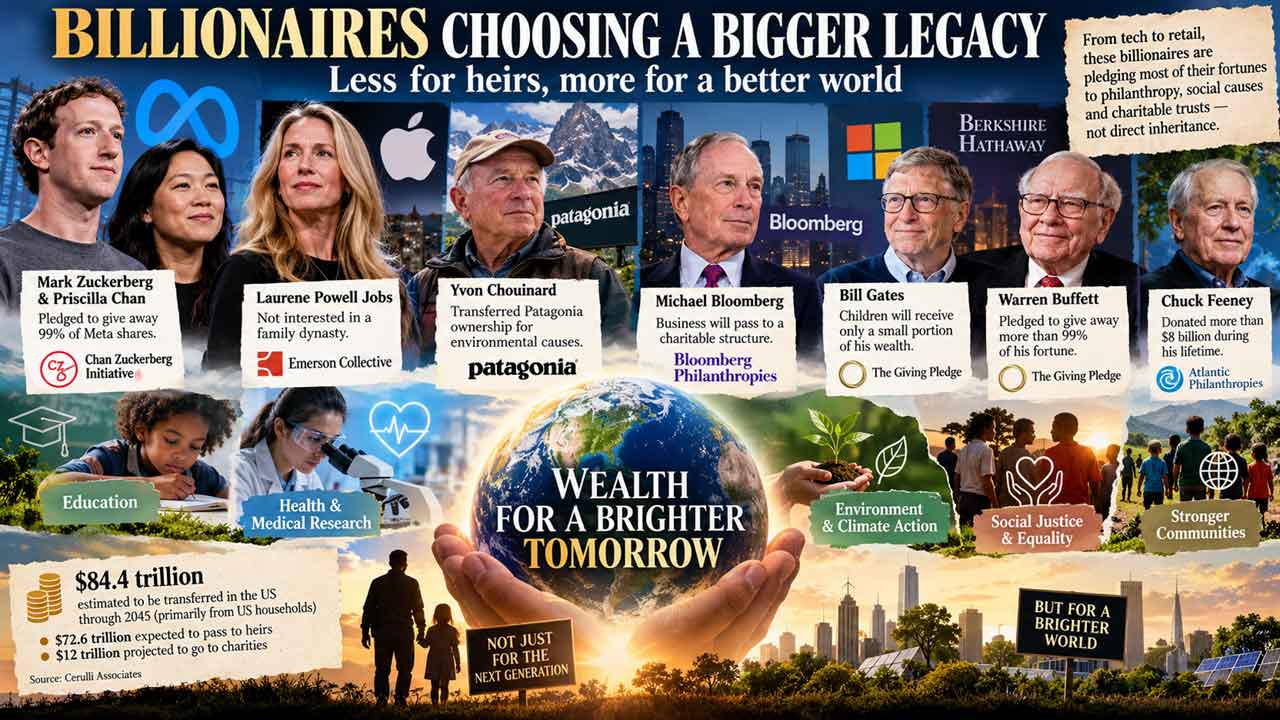
A widely misunderstood wealth-transfer estimate
The debate comes amid predictions of a historic transfer of assets between generations. A frequently cited estimate by wealth-management research firm Cerulli Associates projected that approximately $84.4 trillion would be transferred in the United States through 2045.
That estimate applies primarily to wealth held by US households, rather than representing a direct forecast for the entire world. It includes about $72.6 trillion expected to pass to heirs and nearly $12 trillion projected to go to charities.
Mark Zuckerberg and Priscilla Chan
Meta Platforms founder Mark Zuckerberg and his wife, paediatrician Priscilla Chan, announced in 2015 that they intended to give away 99 per cent of their Meta shares over their lifetimes.
The announcement came after the birth of their first daughter. The couple said the resources would be used to advance areas including education, medical research and equality through the Chan Zuckerberg Initiative.
The organisation was established as a limited liability company, giving it greater flexibility than a conventional charitable foundation to make grants, investments and participate in public-policy advocacy. Zuckerberg and Chan have said returns from its investments would be used to support its broader mission.
Laurene Powell Jobs
Laurene Powell Jobs, who inherited substantial holdings following the death of Apple co-founder Steve Jobs in 2011, has said she is not interested in building a family dynasty through inherited wealth.
In a 2020 interview, she said her children were aware that she did not intend to preserve the fortune as a multigenerational legacy. Her Emerson Collective supports work in education, immigration, environmental protection and social justice.
Yvon Chouinard and Patagonia
Patagonia founder Yvon Chouinard adopted a different model by transferring ownership of the outdoor clothing company in 2022.
The company’s voting shares were placed in the Patagonia Purpose Trust, which was created to protect its mission and values. Nearly all of its non-voting shares went to the Holdfast Collective, a non-profit entity established to use Patagonia’s available profits for environmental protection and action against climate change.
Chouinard’s children supported the arrangement rather than inheriting the company for their personal financial benefit.
Michael Bloomberg
Bloomberg LP founder Michael Bloomberg has said his business will eventually pass to a structure benefiting Bloomberg Philanthropies instead of becoming a conventional family inheritance.
Bloomberg said in 2023 that the foundation would inherit the company after his death. Tax rules would then require the organisation to sell the business within a prescribed period, with the proceeds supporting its charitable work.
His philanthropic organisation focuses on public health, education, government innovation, the arts and environmental programmes.
Bill Gates and the Giving Pledge
Microsoft co-founder Bill Gates has repeatedly said his three children will receive only a small portion of his wealth and will be expected to establish their own careers.
Gates, his former wife Melinda French Gates and Buffett launched the Giving Pledge in 2010. The initiative encourages billionaires to commit a majority of their wealth to charitable purposes during their lifetimes or through their wills. The pledge is a moral commitment rather than a legally binding contract.
Warren Buffett’s charitable trust plan
Berkshire Hathaway chairman Warren Buffett has argued that wealthy parents should leave their children enough to pursue opportunities but not so much that they have no incentive to work.
Buffett began making major annual donations of Berkshire Hathaway shares in 2006 and has pledged to give away more than 99 per cent of his fortune. Under the succession plan he has publicly described, his remaining wealth will pass to a charitable trust overseen by his three children. They will be required to agree unanimously on its distribution and are expected to deploy the money within roughly a decade.
The example of Chuck Feeney
Duty-free retail entrepreneur Chuck Feeney became one of the best-known advocates of giving while living. Through Atlantic Philanthropies, he donated more than $8 billion to causes including healthcare, education, human rights and peace-building.
The foundation completed its grant-making and closed in 2020. Feeney retained a comparatively modest sum for retirement and died in October 2023, demonstrating an approach centred on distributing wealth during the donor’s lifetime rather than establishing a permanent family fortune.
Although the plans announced by today’s billionaires vary significantly, they reflect a broader discussion about inequality, inherited privilege and the responsibilities attached to private wealth. They remain personal commitments and estate arrangements that may evolve, but their stated direction is clear: most of the money is intended for public-interest causes rather than unrestricted inheritance.