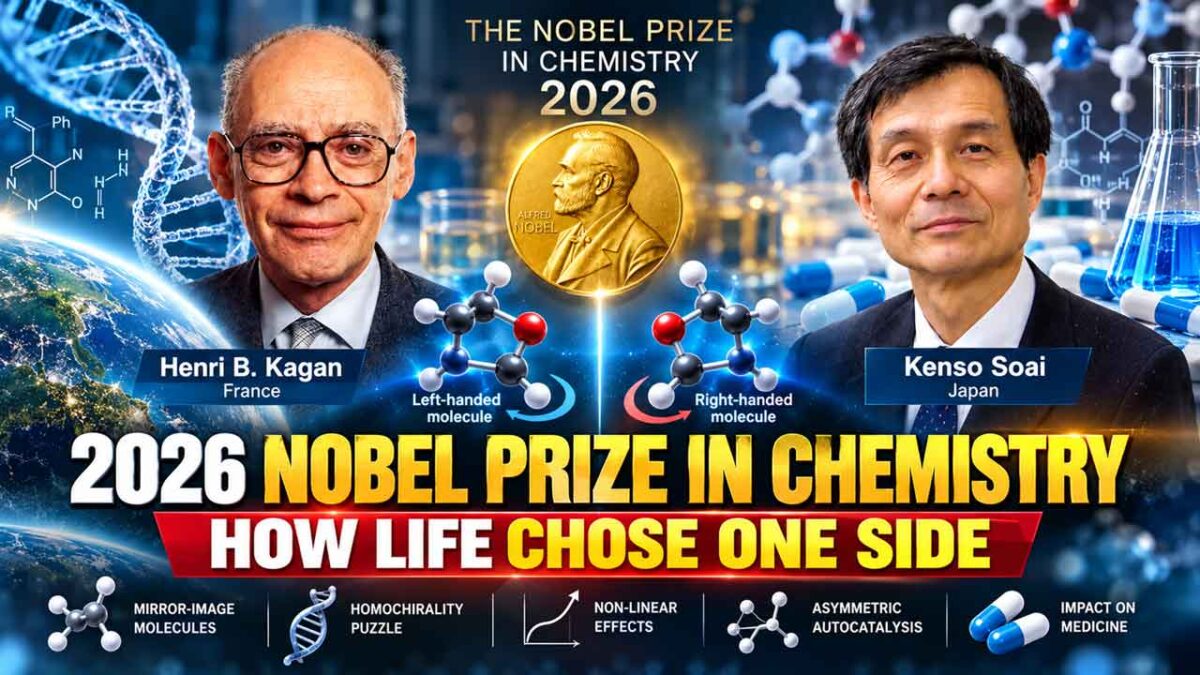
Stockholm, October 7: French chemist Henri B. Kagan and Japanese chemist Kenso Soai have been awarded the 2026 Nobel Prize in Chemistry for pioneering discoveries that helped explain how chemical reactions can favour and amplify one mirror-image form of a molecule over another.
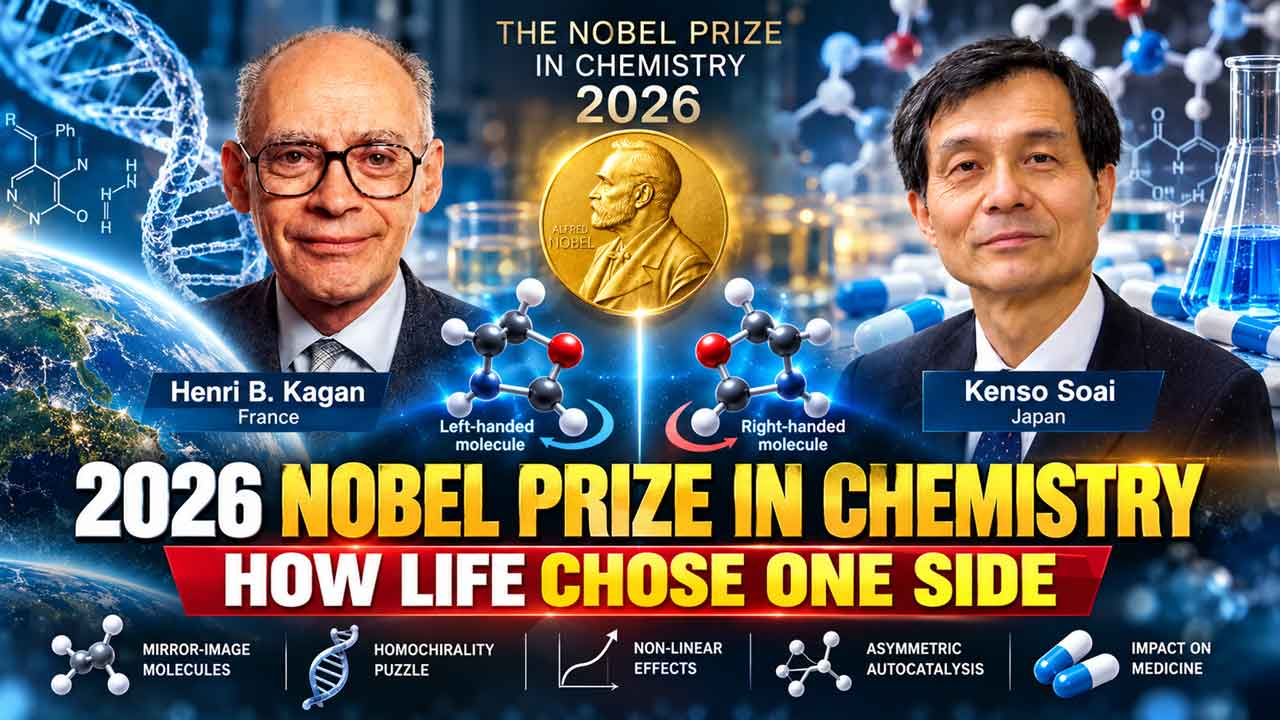
The Royal Swedish Academy of Sciences announced the award on Wednesday, honouring Kagan and Soai “for the discovery of non-linear effects and autocatalysis in asymmetric organic synthesis.”
Their discoveries address one of chemistry’s long-standing mysteries involving chirality, or molecular “handedness.”
Many molecules can exist in two forms that are mirror images of each other, much like a person’s left and right hands. Although the two forms may appear almost identical, they cannot be perfectly superimposed and can behave differently in chemical and biological systems.
This distinction is particularly important in areas such as pharmaceutical development, where controlling which mirror-image form of a molecule is produced can be crucial.
Kagan discovered that asymmetric chemical reactions could display powerful non-linear effects, allowing chemists to obtain a much greater excess of one molecular mirror image than previously expected. His work provided important tools for asymmetric synthesis and influenced the development of methods used to produce pharmaceuticals, flavours, fragrances and new materials.
Soai later made a landmark discovery involving asymmetric autocatalysis. In an autocatalytic reaction, a product of the reaction itself helps accelerate the production of more of that product.
The reaction developed by Soai demonstrated how a very small initial imbalance between two molecular mirror images could be dramatically amplified. The discovery provided scientists with an experimental model for investigating how strong molecular handedness could emerge from an initially tiny imbalance.
The research also has broader implications for understanding homochirality — the phenomenon in which living systems predominantly use particular molecular forms. Scientists have long sought to understand how such molecular preference could have emerged during the chemical processes associated with the origins of life.
The Nobel Committee said the discoveries have given chemists fundamental new tools while contributing to the understanding of how homochirality can arise.
Kagan is affiliated with Université Paris-Sud in France, while Soai is affiliated with Tokyo University of Science in Japan.
The two scientists will share the 2026 Nobel Prize in Chemistry for discoveries that transformed scientists’ understanding of asymmetric organic synthesis and demonstrated how chemistry can select and amplify one molecular “hand” over another.