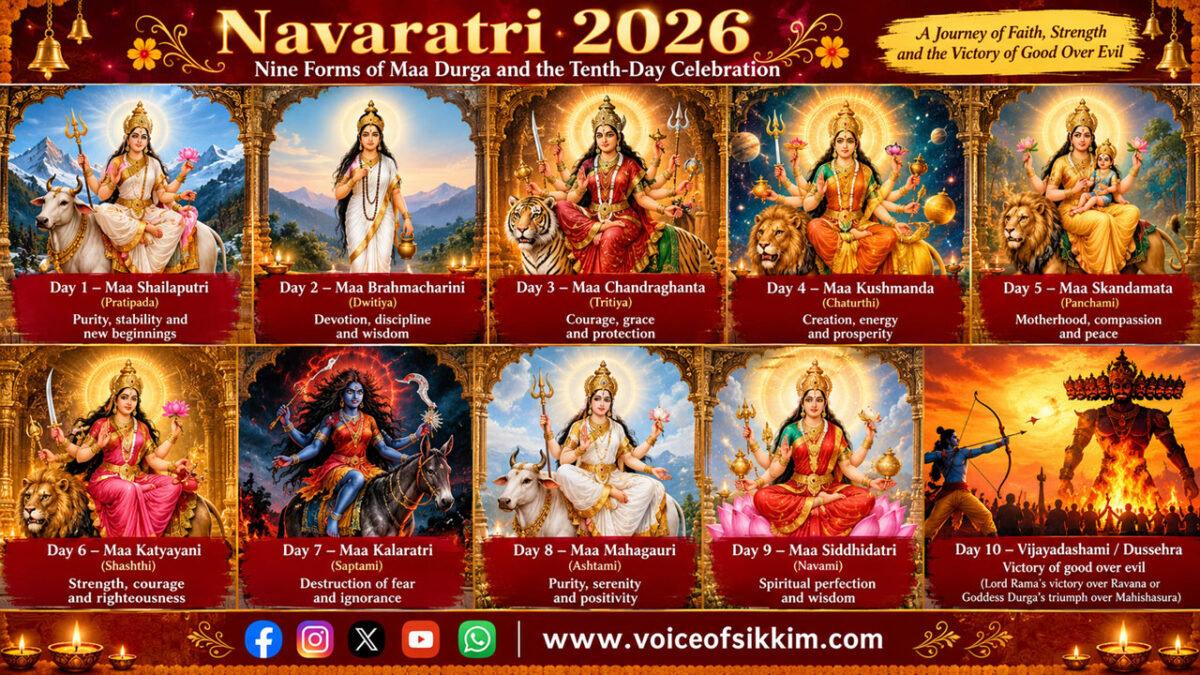
Navratri celebrates the divine power of Goddess Durga through nine sacred nights of devotion, prayer, fasting and spiritual reflection, followed by Vijayadashami or Dussehra on the tenth day. One of Hinduism’s most significant religious festivals, Navratri honours the nine manifestations of Maa Durga, collectively known as Navdurga, each representing a distinct aspect of divine feminine energy, wisdom, courage, compassion and spiritual awakening.
The festival brings together devotees across India to worship Goddess Durga and seek blessings for peace, prosperity, good health, protection and spiritual growth. From the worship of Maa Shailaputri on the first day to Maa Siddhidatri on the ninth, Navratri represents a symbolic journey from spiritual beginnings to enlightenment and fulfilment.
The celebrations culminate in Vijayadashami, commemorating the victory of good over evil through Lord Rama’s triumph over Ravana and Goddess Durga’s victory over Mahishasura.
Here is a comprehensive guide to all ten days of Navratri, exploring the significance, traditional representations, rituals, offerings and spiritual teachings associated with each form of Goddess Durga.
What Is Navratri and Why Is It Celebrated?
Navratri is derived from two Sanskrit words, “Nava,” meaning nine, and “Ratri,” meaning nights. The festival is dedicated to the worship of Shakti, the divine feminine energy believed to sustain, protect and transform the universe.
During these nine nights, devotees worship nine manifestations of Goddess Durga. Each manifestation represents a particular spiritual quality, guiding worshippers towards greater self-awareness, discipline, courage, compassion and wisdom.
Navratri is observed through religious ceremonies, devotional songs, fasting, meditation, temple visits, traditional offerings and community celebrations. Customs vary across regions, reflecting India’s diverse cultural and spiritual traditions.
While the nine days celebrate the different forms of divine energy, the tenth day, Vijayadashami, symbolises the ultimate triumph of righteousness over evil.
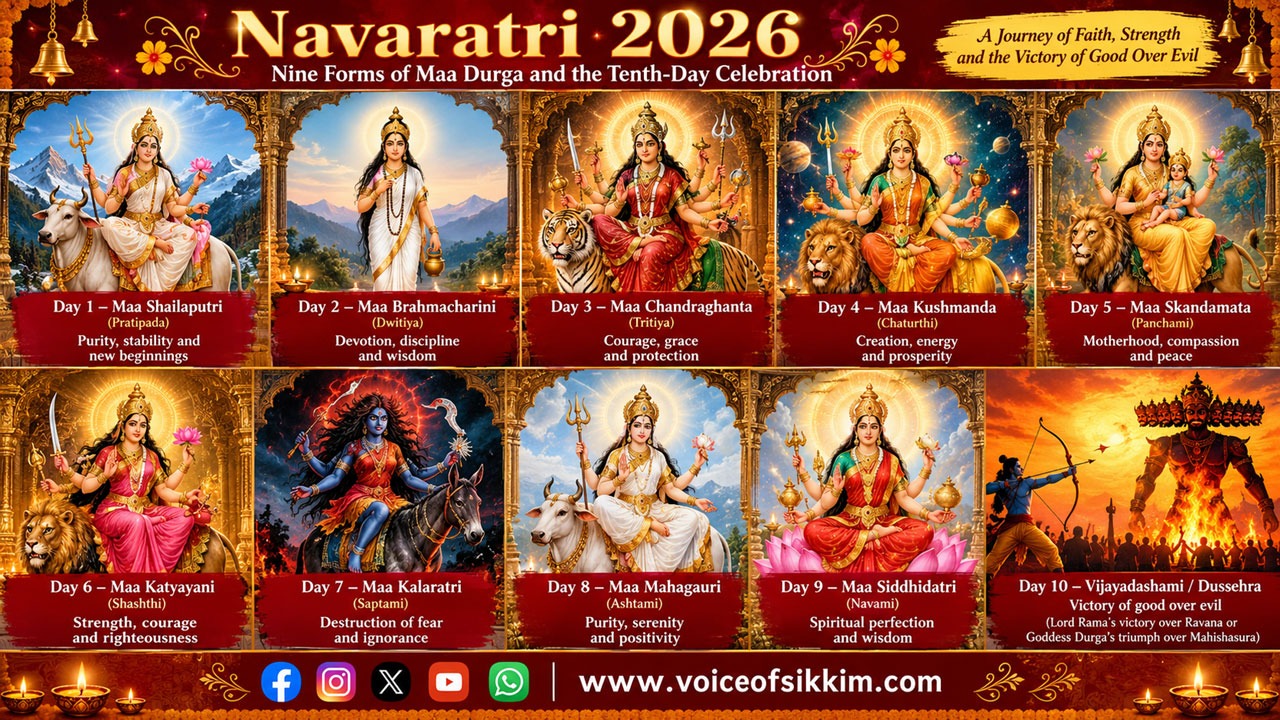
Navratri : Nine Forms of Goddess Durga and the Tenth-Day Celebration
| Day | Goddess or Festival | Spiritual Significance |
|---|---|---|
| Day 1 – Pratipada | Maa Shailaputri | Purity, stability and new beginnings |
| Day 2 – Dwitiya | Maa Brahmacharini | Devotion, discipline and wisdom |
| Day 3 – Tritiya | Maa Chandraghanta | Courage, grace and protection |
| Day 4 – Chaturthi | Maa Kushmanda | Creation, energy and prosperity |
| Day 5 – Panchami | Maa Skandamata | Motherhood, compassion and peace |
| Day 6 – Shashthi | Maa Katyayani | Strength, courage and righteousness |
| Day 7 – Saptami | Maa Kalaratri | Destruction of fear and ignorance |
| Day 8 – Ashtami | Maa Mahagauri | Purity, serenity and positivity |
| Day 9 – Navami | Maa Siddhidatri | Spiritual perfection and wisdom |
| Day 10 – Vijayadashami | Dussehra | Victory of good over evil |
Navratri Day 1: Maa Shailaputri – Goddess of Strength, Purity and New Beginnings
The first day of Navratri begins with the worship of Maa Shailaputri, the first manifestation of Goddess Durga. She symbolises purity, determination, spiritual strength and the beginning of a sacred journey.
The name Shailaputri originates from the Sanskrit words “Shaila,” meaning mountain, and “Putri,” meaning daughter. She is revered as the Daughter of the Mountain.
According to Hindu mythology, Maa Shailaputri is the reincarnation of Goddess Sati, who was reborn as the daughter of Himavat, the King of the Himalayas, and later married Lord Shiva.
Divine Appearance and Symbolism
Maa Shailaputri is traditionally depicted riding a bull, carrying a trident in her right hand and a lotus in her left. A crescent moon adorns her forehead, representing her connection with Lord Shiva.
She is associated with the Moon and the Muladhara, or Root Chakra, regarded in yogic traditions as the foundation of spiritual development.
Devotees believe that worshipping Maa Shailaputri brings stability, emotional balance, inner peace and strength to overcome difficulties.
Ghatasthapana and First-Day Rituals
The first day is marked by Ghatasthapana, an important religious ceremony performed to invoke divine blessings.
Devotees prepare a sacred Kalash containing water, Ganga Jal and traditional offerings. The vessel is placed over soil and grains, with a coconut wrapped in red cloth positioned above it.
An Akhand Jyoti, or continuously burning sacred lamp, is traditionally lit during the festival.
Pure ghee is offered as bhog to Maa Shailaputri, with devotees associating this offering with prayers for good health and protection.
The first day encourages faith, discipline, compassion and a strong spiritual foundation.
Navratri Day 2: Maa Brahmacharini – Goddess of Devotion, Penance and Wisdom
The second day of Navratri honours Maa Brahmacharini, the divine embodiment of patience, self-discipline, perseverance and spiritual wisdom.
Her name signifies one who follows the path of spiritual knowledge and disciplined living.
According to Hindu mythology, Maa Brahmacharini represents Goddess Parvati during her intense meditation and austerities to attain Lord Shiva as her husband.
Her extraordinary penance, lasting thousands of years according to traditional accounts, reflects unwavering determination and the power of devotion.
Divine Appearance and Spiritual Meaning
Maa Brahmacharini is depicted walking barefoot in simple white attire.
She carries a japamala, or prayer beads, in her right hand and a kamandalu, or water pot, in her left.
These objects represent meditation, simplicity, purity and spiritual knowledge.
Her peaceful appearance demonstrates that genuine strength can emerge through self-control, patience and determination.
In certain yogic traditions, she is associated with the Swadhisthana Chakra, linked to emotional balance, creativity and inner awareness.
Puja Rituals and Offerings
Devotees observe fasting, offer flowers and fruits, chant sacred mantras and practise meditation.
Sugar is traditionally regarded as a special offering to Maa Brahmacharini.
Her worship is believed to bring emotional stability, patience, wisdom and the strength to face life’s challenges.
The second day teaches that perseverance and unwavering faith are essential to overcoming obstacles and achieving spiritual fulfilment.
Navratri Day 3: Maa Chandraghanta – Goddess of Courage, Grace and Divine Protection
The third day of Navratri is dedicated to Maa Chandraghanta, who represents bravery, compassion, peace and divine protection.
Her name combines “Chandra,” meaning moon, and “Ghanta,” meaning bell.
She is distinguished by the crescent moon on her forehead, resembling the shape of a bell.
According to Hindu tradition, Maa Chandraghanta represents the married form of Goddess Parvati.
Divine Appearance and Symbolism
Maa Chandraghanta is traditionally depicted riding a tiger or lion, with ten arms carrying various weapons and sacred objects.
Although she possesses a powerful warrior appearance, her expression reflects serenity and compassion.
She represents the balance between courage and kindness, reminding devotees that strength should be guided by wisdom and righteousness.
Maa Chandraghanta is associated with the Manipura Chakra, representing determination, personal strength and confidence.
Worship and Religious Significance
Devotees offer flowers, incense, prayers and traditional offerings while seeking protection from fear, obstacles and negative influences.
Grey is associated with the third day in many Navratri colour traditions, symbolising balance, resilience and strength.
The worship of Maa Chandraghanta encourages devotees to confront adversity without losing compassion or inner peace.
Her spiritual message emphasises that true courage includes overcoming anger, fear and negativity within oneself.
Navratri Day 4: Maa Kushmanda – Divine Creator of the Universe and Source of Cosmic Energy
The fourth day celebrates Maa Kushmanda, revered as the divine creator of the universe and the source of cosmic light, warmth and energy.
According to Hindu religious tradition, Maa Kushmanda brought the universe into existence through her radiant smile, dispelling the darkness that existed before creation.
Her name is traditionally associated with the cosmic egg, symbolising the origin of the universe.
Devotees believe that the goddess resides at the centre of the Sun and radiates the energy that sustains life.
Eight-Armed Form of Maa Kushmanda
Maa Kushmanda is depicted with eight arms and is therefore known as Ashtabhuja Devi.
She holds sacred objects, including a lotus, bow, arrow, discus, mace, rosary and vessels containing divine nectar.
Riding a lion, she symbolises strength, wisdom, courage and the creative power of the universe.
Puja Rituals and Blessings
Devotees offer flowers, fruits, sweets and prayers to seek her blessings for happiness, prosperity and spiritual well-being.
Maa Kushmanda is associated with the Anahata, or Heart Chakra, representing love, compassion and emotional harmony.
Her worship symbolises the triumph of light over darkness and encourages optimism, confidence and spiritual awakening.
The fourth day reminds devotees of the importance of hope, gratitude and the positive energy believed to sustain creation.
Navratri Day 5: Maa Skandamata – Divine Mother of Lord Kartikeya
The fifth day of Navratri honours Maa Skandamata, the mother of Lord Kartikeya, also known as Skanda.
She represents maternal love, compassion, protection, wisdom and the nurturing power of motherhood.
The name Skandamata combines “Skanda,” referring to Lord Kartikeya, and “Mata,” meaning mother.
According to Hindu mythology, Lord Kartikeya is the son of Lord Shiva and Goddess Parvati and is regarded as the commander of the divine army.
Divine Appearance and Symbolism
Maa Skandamata is traditionally depicted with four arms, seated on a lion while holding her infant son on her lap.
She carries lotus flowers in two hands, supports Lord Kartikeya with another and raises her remaining hand in a gesture of blessing.
Her association with the lotus also gives her the name Padmasana Devi.
She symbolises unconditional love, courage, purity and spiritual enlightenment.
In certain yogic traditions, she is associated with the Vishuddha, or Throat Chakra, representing communication, purity and spiritual expression.
Puja Rituals, Offerings and Mantra
Devotees offer flowers, incense, fruits and sweets to Maa Skandamata.
Bananas are traditionally considered a favoured offering, while yellow flowers are also presented during worship.
Rituals include lighting a diya, chanting mantras, performing aarti and praying for family well-being.
A widely recited mantra dedicated to Maa Skandamata is:
ॐ देवी स्कन्दमातायै नमः॥
Om Devi Skandamatayai Namah.
Her worship reminds devotees of the sacred relationship between mother and child and the importance of kindness, patience, selflessness and family harmony.
Navratri Day 6: Maa Katyayani – Fierce Warrior Goddess of Courage and Victory
The sixth day of Navratri is dedicated to Maa Katyayani, one of the most powerful warrior manifestations of Goddess Durga.
She represents strength, courage, righteousness and the determination to confront evil and injustice.
According to Hindu mythology, sage Katyayan performed intense penance seeking the blessing of Goddess Durga as his daughter.
Maa Katyayani is believed to have manifested through the combined divine energies of the gods to defeat the demon Mahishasura and restore righteousness.
Divine Appearance and Powers
Maa Katyayani is depicted riding a lion and possessing four arms.
She holds a sword and lotus, while her remaining hands display Abhaya Mudra, symbolising protection, and Varada Mudra, representing blessings.
Her form reflects fearlessness, determination and divine authority.
She is associated with the Ajna, or Third Eye Chakra, which represents intuition, wisdom and inner awareness.
Puja Rituals and Traditional Beliefs
Devotees offer prayers, flowers, incense and traditional bhog.
Honey is considered a particularly auspicious offering to Maa Katyayani.
Her worship is associated with courage, prosperity, protection and the ability to overcome difficulties.
Maa Katyayani is also traditionally worshipped by unmarried women seeking a suitable life partner.
Hindu tradition connects her worship with the Katyayani Vrata observed by the gopis of Vrindavan, who prayed to the goddess for Lord Krishna as their husband.
The sixth day encourages devotees to uphold truth, confront injustice and cultivate both physical and spiritual courage.
Navratri Day 7: Maa Kalaratri – Fierce Goddess Who Destroys Darkness and Fear
The seventh day of Navratri is dedicated to Maa Kalaratri, the powerful manifestation of Goddess Durga associated with the destruction of darkness, ignorance, fear and evil forces.
Despite her fearsome appearance, Maa Kalaratri is regarded as a compassionate protector of devotees.
Her name combines “Kala,” associated with time or darkness, and “Ratri,” meaning night.
She is also worshipped as Shubhankari, the one who brings auspiciousness and well-being.
Divine Appearance and Symbolism
Maa Kalaratri is depicted with a dark complexion, flowing hair and four arms.
She carries a sword and iron hook, while her remaining hands display gestures of protection and blessing.
Her vehicle is a donkey, symbolising endurance and determination.
According to Hindu tradition, she is associated with the defeat of destructive demonic forces, including Raktabeej.
Her fierce form symbolises the destruction of evil and ignorance rather than harm to sincere devotees.
Maha Saptami Rituals and Offerings
The seventh day is traditionally associated with Maha Saptami.
Devotees light sacred lamps, offer prayers, chant mantras and seek protection from negative influences.
Jaggery is traditionally offered as bhog to Maa Kalaratri.
Her worship is associated with the Sahasrara, or Crown Chakra, representing higher spiritual consciousness.
The seventh day teaches devotees to overcome fear, cultivate inner strength and recognise that courage and wisdom can prevail even in difficult circumstances.
Navratri Day 8: Maa Mahagauri – Goddess of Purity, Peace and Positivity
The eighth day of Navratri celebrates Maa Mahagauri, the divine manifestation of purity, serenity, compassion and spiritual renewal.
Traditionally observed as Durga Ashtami or Maha Ashtami, the day holds immense religious significance.
The name Mahagauri represents extraordinary radiance and purity.
According to Hindu mythology, Goddess Parvati underwent intense penance to attain Lord Shiva as her husband.
Her devotion and austerities are associated with her transformation into the radiant form of Maa Mahagauri.
Divine Appearance and Symbolism
Maa Mahagauri is traditionally depicted wearing white garments and riding a white bull.
She has four arms, holding a trident and a damaru, while her remaining hands display gestures of protection and blessing.
Her peaceful appearance symbolises innocence, tranquillity, compassion and the triumph of goodness over negativity.
Devotees believe her blessings help remove obstacles and bring harmony, emotional balance and spiritual growth.
Durga Ashtami and Kanya Puja
Devotees observe fasting, perform special prayers and offer flowers, sweets and other traditional offerings.
Kanya Puja is an important ritual associated with Ashtami in many Hindu traditions.
During the ceremony, young girls are worshipped as manifestations of the Divine Feminine and offered food and gifts.
The ritual symbolises reverence for feminine divinity and the values of compassion, respect and nurturing.
The eighth day encourages purity in thought, kindness in action and unwavering faith.
Navratri Day 9: Maa Siddhidatri – Goddess of Spiritual Powers, Wisdom and Perfection
The ninth day of Navratri honours Maa Siddhidatri, the final manifestation among the nine forms of Goddess Durga.
She is revered as the divine giver of spiritual powers, wisdom, prosperity and perfection.
Her name combines “Siddhi,” meaning spiritual accomplishment or supernatural power, and “Datri,” meaning giver.
According to Hindu mythology, Maa Siddhidatri possesses the power to grant eight divine perfections known as Ashta Siddhis.
These are Anima, Mahima, Garima, Laghima, Prapti, Prakamya, Ishitva and Vashitva.
Divine Appearance and Spiritual Significance
Maa Siddhidatri is depicted seated on a fully bloomed lotus or riding a lion.
She has four arms, carrying a discus, conch, mace and lotus.
Her serene appearance represents divine knowledge, spiritual fulfilment and the unity of wisdom and strength.
Hindu tradition also associates Maa Siddhidatri with Lord Shiva and the concept of Ardhanarishvara, representing the inseparable unity of masculine and feminine energies.
Maha Navami Rituals and Kanya Puja
On Maha Navami, devotees perform special prayers and offer flowers, fruits and sweets.
Kanya Puja, also known as Kumari Puja, may be performed on Ashtami or Navami, depending on regional customs.
Young girls are honoured as manifestations of divine feminine energy and offered food and gifts.
Maa Siddhidatri represents the culmination of the nine-day spiritual journey.
Her worship teaches that true perfection is not limited to material success but includes wisdom, compassion, self-realisation and inner peace.
Navratri Day 10: Vijayadashami and Dussehra – Victory of Good Over Evil
The tenth day of Navratri celebrations is observed as Vijayadashami or Dussehra, symbolising the triumph of righteousness, truth and justice over evil, arrogance and wrongdoing.
The festival commemorates two important victories in Hindu tradition: Lord Rama’s victory over Ravana and Goddess Durga’s triumph over Mahishasura.
Lord Rama’s Victory Over Ravana
According to the Ramayana, Lord Rama defeated the demon king Ravana after a fierce battle.
The victory represents the triumph of dharma, or righteousness, over adharma, or unrighteousness.
In many parts of India, Dussehra is celebrated through dramatic performances of the Ramayana and the ceremonial burning of towering effigies of Ravana.
The tradition symbolises the destruction of arrogance, injustice and evil.
Goddess Durga’s Triumph Over Mahishasura
Vijayadashami also commemorates Goddess Durga’s victory over the buffalo demon Mahishasura.
According to Hindu mythology, Goddess Durga confronted and defeated Mahishasura, restoring peace and righteousness.
Her victory represents the power of divine feminine energy, courage and justice.
Durga Visarjan and Festive Celebrations
In regions celebrating Durga Puja, Vijayadashami marks the ceremonial farewell to Goddess Durga.
Devotees participate in Durga Visarjan, the immersion of the goddess’s idols in water, accompanied by prayers and traditional rituals.
The ceremony represents a devotional farewell and the hope of welcoming the goddess again during the next celebration.
Vijayadashami concludes the sacred festivities with a message that goodness, truth and righteousness ultimately prevail.
Spiritual Significance of the Nine Forms of Maa Durga
The worship of Navdurga represents more than nine separate religious observances. Together, the manifestations symbolise a progressive spiritual journey.
Maa Shailaputri establishes the foundation of faith and stability, while Maa Brahmacharini teaches patience and disciplined devotion.
Maa Chandraghanta inspires courage and compassion, and Maa Kushmanda represents creativity, light and the sustaining energy of the universe.
Maa Skandamata reflects maternal love and selflessness, while Maa Katyayani encourages strength and the determination to uphold righteousness.
Maa Kalaratri represents the destruction of fear and ignorance, followed by Maa Mahagauri, who symbolises purification and renewal.
Finally, Maa Siddhidatri represents wisdom, spiritual fulfilment and the attainment of higher consciousness.
The progression culminates in Vijayadashami, reinforcing the belief that truth and goodness triumph over evil.
Traditional Navratri Puja Rituals and Offerings
Navratri worship involves a variety of religious practices that differ across families, communities and regions.
Many devotees begin with Ghatasthapana and the lighting of a sacred lamp. Daily worship may include offering flowers, fruits, incense, sweets and other traditional bhog to the goddess.
Fasting, chanting mantras, performing aarti and visiting temples are common expressions of devotion.
Some devotees observe strict fasting, while others follow dietary restrictions or participate in prayers according to their individual traditions.
Special ceremonies such as Kanya Puja are performed on Ashtami or Navami in many communities.
These practices are intended to encourage spiritual discipline, gratitude, compassion and a closer connection with divine feminine energy.
The Message of Navratri : Faith, Courage, Compassion and Righteousness
Navratri carries a spiritual message that extends beyond religious ceremonies.
The nine forms of Goddess Durga represent qualities that remain meaningful in everyday life, including patience, courage, wisdom, compassion, resilience and determination.
The festival encourages devotees to overcome fear, anger, ignorance and negativity while embracing kindness, self-discipline and moral responsibility.
Vijayadashami reinforces this message through the symbolic victory of good over evil.
Together, the nine sacred nights and the tenth-day celebration remind devotees that spiritual growth is achieved through devotion, righteous action, inner strength and compassion towards others.
Frequently Asked Questions About Navratri
What is the significance of Navratri?
Navratri is a Hindu festival dedicated to the worship of Goddess Durga and her nine manifestations. It celebrates divine feminine energy, spiritual strength, wisdom, compassion and the victory of good over evil.
Which goddess is worshipped on the first day of Navratri?
Maa Shailaputri is worshipped on the first day. She represents purity, strength, stability and new beginnings.
What are the nine forms of Goddess Durga?
The nine forms are Maa Shailaputri, Maa Brahmacharini, Maa Chandraghanta, Maa Kushmanda, Maa Skandamata, Maa Katyayani, Maa Kalaratri, Maa Mahagauri and Maa Siddhidatri.
Why is Kanya Puja performed during Navratri?
Kanya Puja is performed to honour young girls as manifestations of divine feminine energy. The ceremony is traditionally observed on Ashtami or Navami, depending on regional customs.
What is celebrated on the tenth day of Navratri?
The tenth day is celebrated as Vijayadashami or Dussehra. It commemorates Lord Rama’s victory over Ravana and Goddess Durga’s triumph over Mahishasura.
What is the spiritual message of Navratri?
Navratri teaches the importance of faith, patience, courage, compassion, self-discipline and wisdom. It encourages devotees to overcome negativity and follow the path of righteousness.
Conclusion
Navratri represents a sacred journey through nine manifestations of Goddess Durga, each offering a distinct spiritual lesson and reminding devotees of the transformative power of divine feminine energy.
Beginning with Maa Shailaputri and concluding with Maa Siddhidatri, the festival honours devotion, courage, compassion, purity and wisdom.
The celebrations culminate in Vijayadashami, when the victories of Lord Rama and Goddess Durga symbolise the enduring triumph of truth and righteousness.
As devotees celebrate Navratri and Dussehra, the festival serves as a reminder that genuine spiritual strength lies in faith, self-discipline, compassion and the determination to overcome evil with goodness.
