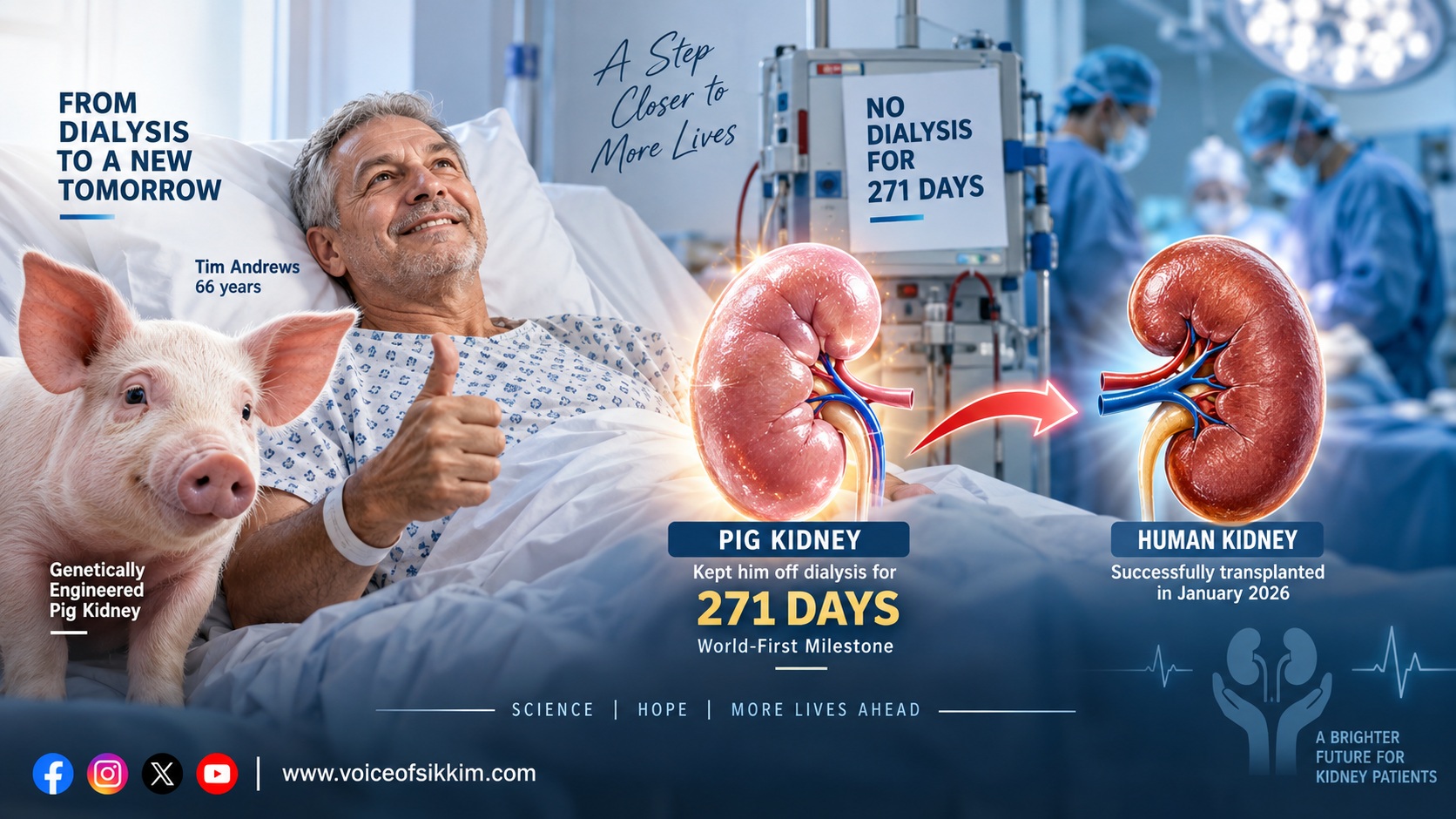
Boston, Sep 6: In a major breakthrough for transplant medicine, a genetically engineered pig kidney kept a man suffering from end-stage kidney failure free from dialysis for 271 days, before he successfully transitioned to a human donor kidney — marking a world-first milestone in animal-to-human organ transplantation.
The case, involving Tim Andrews, has provided some of the strongest evidence yet that genetically modified animal organs could one day serve as a temporary lifeline for patients waiting years for a suitable human donor organ.
Researchers from Massachusetts General Hospital and Mass General Brigham detailed the case in a study published in The Lancet on September 3, 2026.
Pig Kidney Worked for 271 Days Without Dialysis
Andrews was 66 years old when he received the genetically engineered pig kidney in January 2025.
He was suffering from end-stage kidney disease and had previously been undergoing haemodialysis.
Following the xenotransplant — the transplantation of an organ between different species — the pig kidney began functioning immediately.
According to researchers, Andrews was able to remain completely free from dialysis for 271 days, or nearly nine months, while the transplanted organ supported his kidney function.
The achievement represents the longest dialysis-free survival reported in a living human following a pig-kidney xenotransplant.
More significantly, Andrews subsequently became the first patient to successfully move from a pig kidney transplant to a human kidney transplant.
Years-Long Wait for Human Kidney
Before undergoing the experimental procedure, Andrews had no available living kidney donor and faced a lengthy wait for a deceased-donor organ.
Researchers reported that his expected waiting time for a human kidney exceeded five years, while estimates suggested that his probability of receiving a transplant was relatively low compared with the risk of dying or being removed from the waiting list.
The experimental pig kidney therefore offered doctors a potential way of keeping him off dialysis while he continued waiting for a human organ.
Genetically Engineered Pig Kidney
The transplanted kidney was not taken from an ordinary pig.
It had been extensively genetically modified to improve compatibility with the human immune system and reduce some of the biological risks associated with transplanting an animal organ into a human recipient.
Doctors closely monitored Andrews for kidney function, rejection, antibody development and possible transmission of pig pathogens.
An early episode of T-cell-mediated rejection was successfully treated.
Importantly, researchers reported that no transmission of pig pathogens was detected during the period of observation.
Why Did the Pig Kidney Eventually Fail?
Despite functioning for several months, complications eventually developed.
Researchers said immunosuppressive treatment had to be reduced after Andrews developed an infection.
The transplanted kidney later developed microvascular injury and inflammation, which progressively damaged the organ and ultimately resulted in graft failure.
The pig kidney was subsequently removed.
The failure is important scientifically because researchers believe understanding the mechanism behind the late-stage damage could help improve future genetic modifications, immune-suppression strategies and monitoring of xenotransplant patients.
Human Kidney Transplant Successfully Follows Pig Kidney
After returning temporarily to dialysis, Andrews received a kidney from a deceased human donor in January 2026.
The human kidney began functioning immediately.
Crucially, doctors found no evidence that receiving the pig kidney had caused immune sensitisation that would prevent or seriously complicate transplantation of a human kidney.
This makes Andrews’ case particularly significant.
Rather than viewing xenotransplantation only as a permanent replacement for a failing human organ, scientists are increasingly investigating whether animal organs could function as a temporary biological bridge until an appropriate human donor becomes available.
Could Pig Kidneys Help Solve Organ Shortage?
The shortage of suitable human organs remains one of the biggest challenges facing transplant medicine worldwide.
Lead researcher Dr Leonardo Riella of Mass General Brigham said transplantation remains the best treatment for many patients with end-stage kidney failure, but there are simply not enough human organs available to meet demand.
Researchers envision xenotransplantation initially being used to help patients escape prolonged dialysis while waiting for a human kidney.
If future studies establish greater safety and long-term durability, genetically engineered animal organs could potentially develop into a treatment option of their own.
Breakthrough Comes With Important Caution
Despite the encouraging result, researchers have stressed that Andrews represents a single patient, not proof that pig kidney transplantation is ready for widespread clinical use.
His treatment involved careful patient selection, experimental regulatory approval, extensive monitoring and highly specialised medical care.
Questions also remain about long-term organ survival, immune rejection, infection risks and the optimal genetic modifications required for animal organs.
Further clinical studies involving larger numbers of patients will therefore be necessary before xenotransplantation can become routine medical treatment.
Nevertheless, Andrews’ 271 dialysis-free days — followed by a successful human kidney transplant — represent an important step towards determining whether genetically engineered pig organs could eventually help address the global shortage of donor kidneys.