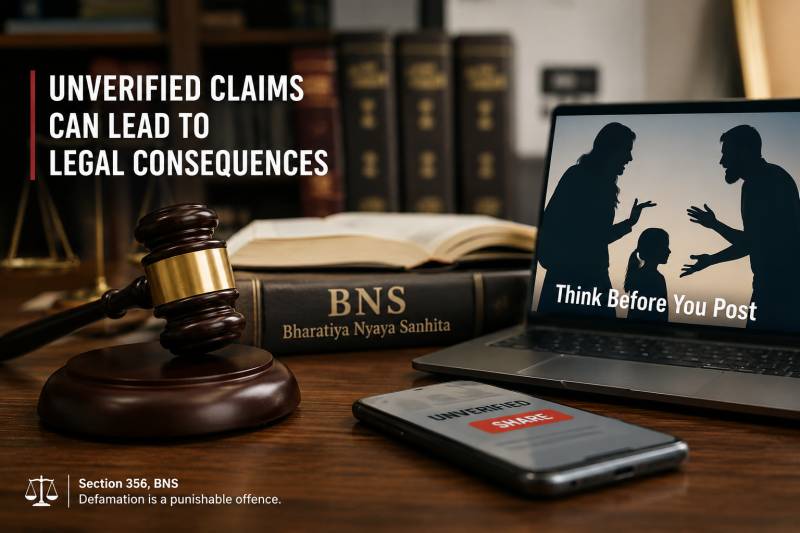

The Bharatiya Nyaya Sanhita (BNS), 2023 does not grant social media users, journalists, or digital news platforms any special exemption to publish unverified allegations arising from private family disputes. Legal experts note that such publications may expose individuals and publishers to criminal defamation proceedings and other legal consequences if the information is false, misleading, or published without due verification.
Defamation Under Section 356 of the BNS
Section 356 of the Bharatiya Nyaya Sanhita makes it an offence to publish any statement or imputation that harms a person’s reputation when it is made with the intention to cause harm or with knowledge that it is likely to damage that person’s reputation. The provision applies equally to newspapers, television, online news portals, websites, and social media platforms.
The prescribed punishment may include up to two years’ simple imprisonment, a fine, community service, or any combination of these penalties.
Importantly, the law does not create any exception for private family disputes. Explanation 1 to Section 356 also extends protection to statements that adversely affect the reputation of a person’s family or near relatives.
Limited Legal Exceptions
The BNS recognises certain exceptions to defamation, including:
Publication of truthful information made for the public good.
Fair comment on the public conduct of public servants.
Fair and accurate reporting of judicial or legislative proceedings made in good faith.
Other recognised exceptions based on good faith and public interest.
However, publishing allegations without verifying their accuracy does not qualify as a legal defence. The protection available under the law depends on good faith, responsible journalism, and genuine public interest rather than speed of publication or social media virality.
Risks of Publishing Unverified Allegations
Legal experts caution that publishing unverified claims can have serious consequences. If an allegation is later found to be false, it may undermine any claim that the publisher acted in good faith.
Depending on the nature of the content, other provisions of the Bharatiya Nyaya Sanhita relating to criminal intimidation, public mischief, or offences affecting an individual’s dignity or privacy may also become applicable.
Additionally, digital publishers remain subject to the Information Technology Act, 2000 and the Information Technology (Intermediary Guidelines and Digital Media Ethics Code) Rules, 2021, which require digital news platforms to maintain grievance redressal mechanisms and comply with lawful takedown directions.
The Bharatiya Sakshya Adhiniyam also recognises electronic records—including screenshots, videos, audio recordings, and social media posts—as admissible evidence in legal proceedings, making online publications easier to rely upon in court.
Guidance for Digital News Publishers
Private family disputes are not automatically matters of public interest. Before reporting such allegations, news organisations should ensure that the information has been independently verified, serves a genuine public interest rather than mere public curiosity, and is presented in a fair, balanced, and non-malicious manner.
Publishing rumours or one-sided allegations without adequate verification may expose both the individual publisher and the news organisation to criminal defamation complaints as well as civil claims for damages.
This article is intended for general informational purposes and should not be construed as legal advice. For specific cases involving potential legal liability, professional legal consultation is recommended.