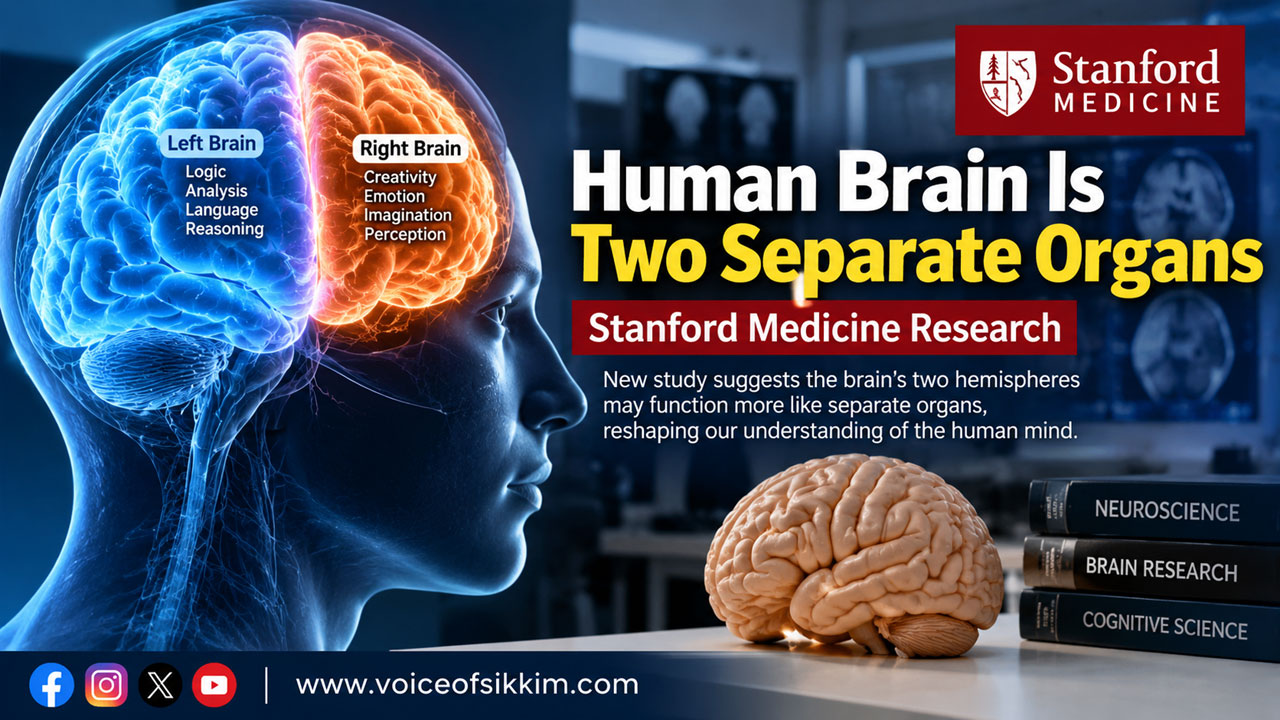
California, September 19 : A new study led by Stanford Medicine has revealed that the human brain develops from two distinct groups of embryonic cells, challenging the long-held understanding that the entire brain originates from a single common population of precursor cells.
Published in Nature Neuroscience on September 18, the research suggests that the brain consists of two ancient nervous systems that followed separate evolutionary and developmental pathways before becoming integrated into a single organ.

The findings could transform scientists’ understanding of brain development and provide new opportunities to investigate neurological diseases affecting the brainstem.
Human Brain Develops From Two Different Cell Groups
The human brain is traditionally divided into three major regions: the forebrain, midbrain and hindbrain.
The forebrain is involved in higher cognitive functions, including language, consciousness, reasoning and abstract thinking. The hindbrain and associated brainstem structures play crucial roles in essential bodily functions such as breathing, heartbeat regulation, sleep and swallowing.
For decades, scientists believed that these regions developed from a common population of early embryonic cells that gradually differentiated into specialised brain structures.
However, Stanford researchers discovered that the front and back of the brain originate from two distinct populations of progenitor cells.
Their experiments on developing mouse embryos identified two separate developmental pathways.
Cells expressing the Otx2 gene contribute to the forebrain and midbrain, while cells expressing the Gbx2 gene develop into the hindbrain.
The researchers found that these two populations followed separate developmental trajectories from the earliest stages examined.
The findings suggest that the brain’s different regions are established through more distinct developmental programmes than previously understood.
Discovery Could Explain a Long-Standing Scientific Mystery
One of the major challenges in neuroscience has been producing authentic human hindbrain neurons in laboratory conditions.
These specialised nerve cells control important functions involving facial muscles, speech, swallowing and other essential activities.
Previous attempts to generate them from stem cells had produced limited results, restricting researchers’ ability to study diseases affecting the brainstem.
The Stanford team discovered that the problem may have originated from attempts to develop hindbrain cells using precursor cells already committed to forming the forebrain or midbrain.
By identifying the correct developmental pathway, researchers successfully guided human pluripotent stem cells into becoming functional hindbrain motor neurons.
The laboratory-grown neurons demonstrated electrical activity and produced proteins characteristic of authentic hindbrain cells.
This achievement provides scientists with a new laboratory model for examining how these specialised nerve cells develop and function.
What Does the Discovery Mean for ALS and Spinal Muscular Atrophy?
The findings could have important implications for research into amyotrophic lateral sclerosis (ALS) and spinal muscular atrophy (SMA).
Both diseases can damage motor neurons involved in essential muscular functions, including swallowing and breathing.
Scientists have faced significant difficulties studying affected human brainstem neurons because obtaining living brainstem tissue from patients is generally not feasible.
The ability to produce these neurons from stem cells could allow researchers to examine disease mechanisms more closely and investigate potential therapeutic approaches.
However, the discovery does not represent a cure for ALS, SMA or any other neurological disorder. Further research will be necessary to determine whether the new laboratory models can contribute to effective treatments.
Brain’s Evolutionary History May Extend Back 550 Million Years
The researchers also examined the evolutionary origins of the brain’s two developmental pathways.
They identified similar patterns in several organisms, including chickens, zebrafish and acorn worms, suggesting that the separation between these neural systems may have existed more than 550 million years ago.
The findings support the hypothesis that evolution brought together two ancient neural systems into the integrated brain seen in modern vertebrates.
Importantly, the discovery does not mean that humans possess two physically independent brains. The adult brain remains an interconnected organ whose regions work together.
Instead, the research identifies distinct developmental origins for major brain regions and proposes that their evolutionary histories may also have been separate.
What Happens Next?
The Stanford team plans to extend its research to investigate the developmental origins of the spinal cord and better understand how diseases such as ALS and SMA damage hindbrain neurons.
The ability to produce specialised human nerve cells in laboratory conditions could eventually support more accurate disease models, drug testing and research into regenerative medicine.
Although further investigation is required, the findings offer a new framework for understanding how the brain develops and how its specialised cells might be studied in the laboratory.
The study marks a significant advance in developmental neuroscience, suggesting that the human brain’s apparent unity conceals a much more complex evolutionary and cellular history.
Scientific Reference: Jokhai, R.T., Dundes, C.E., Ahsan, H.S. et al. Two parallel neural ectoderm progenitors contribute to the developing brain. Nature Neuroscience (2026). DOI: 10.1038/s41593-026-02433-7