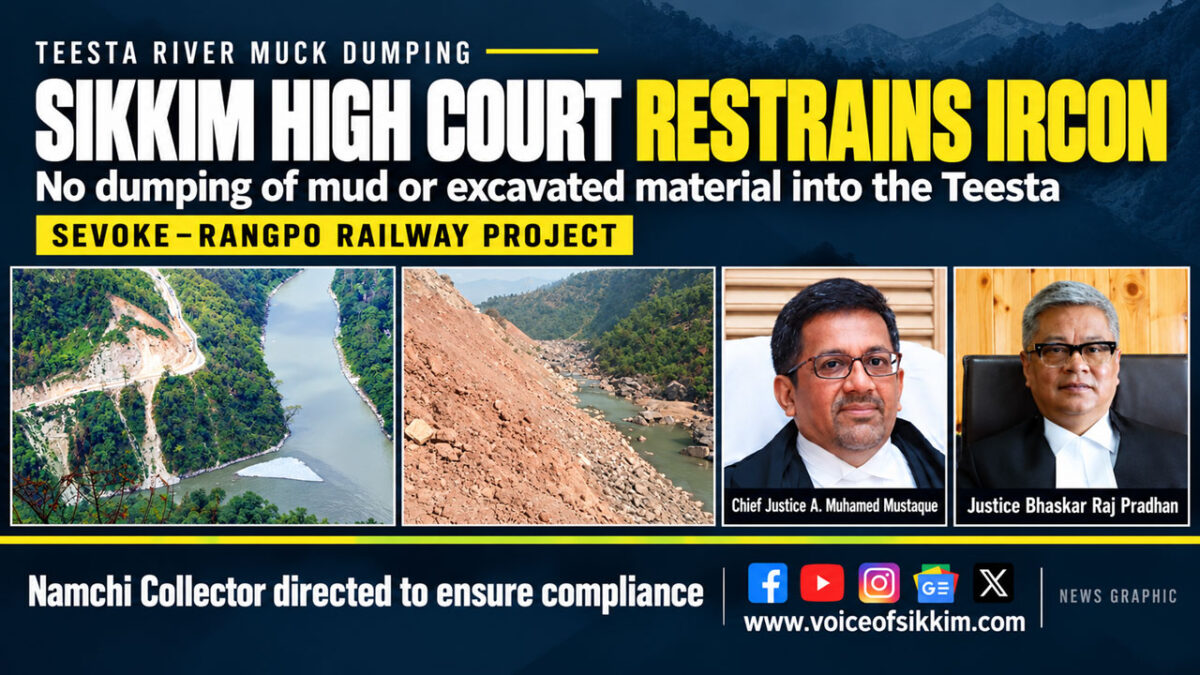
Gangtok, October 17 : Teesta River Muck Dumping linked to the Sevoke-Rangpo Railway Project has been prohibited by the High Court of Sikkim, which has directed IRCON and its contractors to stop disposing of excavated soil, mud and construction debris into the river. The court has also instructed the Namchi District Collector to investigate whether such dumping has affected the Teesta’s natural flow.
The directive came from a Division Bench comprising Chief Justice A. Muhamed Mustaque and Justice Bhaskar Raj Pradhan on October 13, while hearing a public interest litigation concerning the possible impact of railway construction activities on the river near Melli Bazar in Namchi district.
The petition, registered as WP(PIL) No. 09 of 2026, was filed by Damber Bahadur Chhetri against the Project Director of the Sevoke-Rangpo Railway Project, IRCON. It brought before the court allegations that excavated material from the railway works had been deposited along the Teesta river basin, potentially interfering with the river’s natural course.
The Bench considered a report submitted on October 3 by the Secretary of the District Legal Services Authority (DLSA), Namchi, following an earlier judicial direction issued on September 7. The court ordered that copies of the report be furnished to the parties involved in the proceedings.
Expanding the scope of the case, the High Court also brought the District Collector of Namchi and the State Pollution Control Board into the proceedings as additional respondents. The petitioner’s counsel was instructed to provide them with copies of the petition, while the Registry was directed to make available other relevant records.
The court specifically restrained IRCON and its contractors from depositing mud or excavated material in the Teesta River, making it clear that disposal must be confined to authorised locations.
Responsibility for enforcing the restriction has been assigned to the District Collector, Namchi. In the event of any violation, the Collector has been directed to initiate appropriate action against IRCON or its contractors under the Water (Prevention and Control of Pollution) Act, 1974, and the applicable rules.
Beyond preventing further dumping, the High Court has sought an examination of whether the disposal of construction waste has already altered the Teesta’s natural flow.
The District Collector must investigate the matter and, if any disturbance is established, identify measures necessary to address its effects.
The proceedings have drawn attention to environmental concerns surrounding the Sevoke-Rangpo Railway Project, a major infrastructure initiative intended to provide Sikkim with its first connection to India’s national railway network.
The Teesta, which flows through Sikkim before entering West Bengal, is central to the region’s river system. The allegations before the court concern the possible consequences of construction-related dumping on its natural flow.
During the hearing, advocates Rajendra Upreti and Kanchan Rai represented the petitioner. Deblina Chattaraj, appearing through video conferencing, and Prem Simon Chettri appeared for IRCON. Rahul Rathi and Khusboo Rathi represented the second respondent, while Deputy Solicitor General of India Sangita Pradhan, appearing virtually, and Amit Kumar Sharma appeared for the third respondent.
The High Court has fixed November 17, 2026, as the next date of hearing, when the District Collector’s findings on the alleged dumping and its impact on the Teesta are expected to come under consideration.
The court’s directions place responsibility on the district administration to prevent further unauthorised disposal while determining whether corrective intervention is required along the affected stretch of the river.