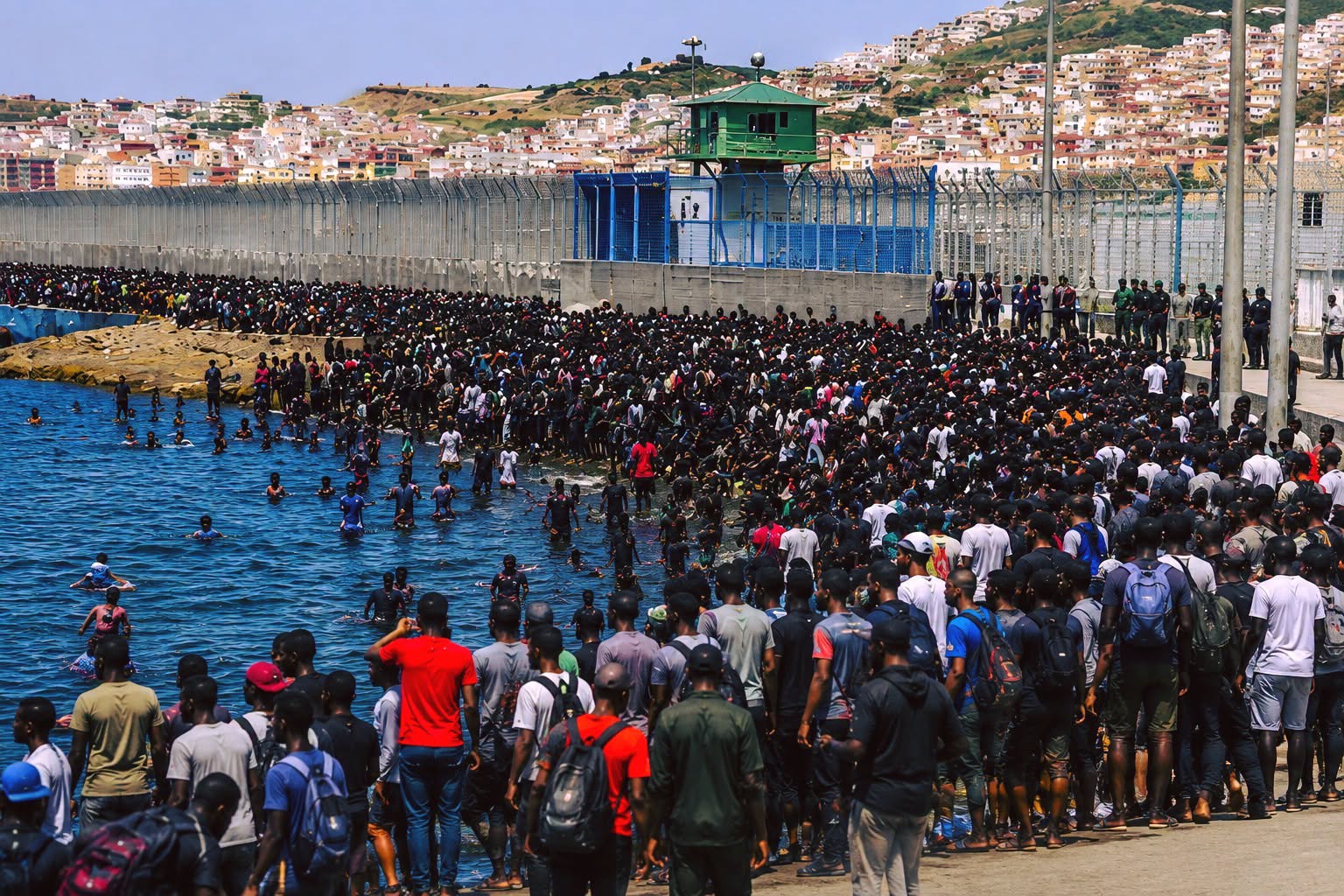
Ceuta, Spain / Rabat, Morocco — August 1: A mass border crisis has erupted at Spain’s North African enclave of Ceuta after tens of thousands of migrants crossed illegally from Morocco over the past two days, in what regional authorities are calling the largest single-incident surge in the border’s history. At least 57 people are confirmed dead, dozens more are injured, and the enclave — home to barely 85,000 residents — has been left struggling under the weight of an influx that at its peak may have touched 60,000 people.
What Happened

The crisis began late Thursday, July 30, and intensified overnight into Friday, July 31, when large crowds of migrants — mostly young men, along with women, children and unaccompanied minors — attempted to enter Ceuta from the Moroccan side. Most crossed by swimming around the Tarajal breakwater with their phones sealed in waterproof pouches, while others crossed on foot along the shoreline or scaled border fencing.
Spain’s Interior Ministry put the number of arrivals between Thursday and Friday at close to 50,000, while Ceuta’s regional president, Juan Jesus Vivas, estimated the two-day total may have reached 60,000 — a figure equivalent to more than half the enclave’s entire population.
By Friday evening, most arrivals had already left. The Interior Ministry reported that more than 48,300 migrants voluntarily returned to Morocco, citing shortages of food, water and shelter in Ceuta, with roughly 25,000 repatriations processed on Friday alone.
The Human Toll
Authorities recovered 57 bodies on the Spanish side of the border, with Ceuta’s regional president warning the toll could still rise. Officials say many victims drowned attempting to swim around the breakwater, while others were killed in a crush of people trying to force their way across the Tarajal fence line. Ceuta’s Civil Guard representative, Rachid Sbihi, described conditions as a serious humanitarian crisis, with thousands — including unaccompanied children — left sleeping on sidewalks and in parks as reception centres were overwhelmed.
On the Moroccan side, security forces used tear gas, batons and water cannon to try to hold back the crowds. A bus and several vehicles were burned in the resulting chaos, and Moroccan police reported injuries among their ranks along with dozens of arrests.
The Legal Trigger
Spanish and Moroccan officials trace the surge to a Spanish Supreme Court ruling issued on June 29, which found that migrants intercepted at sea while trying to reach Ceuta or Melilla cannot be summarily returned to Morocco without following ordinary immigration procedure. The ruling did not legalise irregular entry or guarantee a right to remain in Spain, but Spain’s Interior Ministry says smuggling networks spread a distorted version of the ruling across Moroccan social media, encouraging people to attempt the crossing by sea, where the summary-return rule no longer applied. The ruling does not cover migrants entering by land, such as by climbing the border fence.
Rights activists in Morocco have disputed this explanation, arguing that most migrants attempting the crossing would have had no knowledge of a foreign court’s legal reasoning.
Government and Political Response
Prime Minister Pedro Sánchez travelled to Ceuta on Friday, describing the mass crossing as a violation of Spain’s territorial integrity and blaming trafficking networks for exploiting the court ruling. He announced plans for a temporary reception centre to speed up registration, triage and expulsion of migrants without legal grounds to stay, along with a line of buoys near Tarajal beach to visibly mark the maritime border in line with the court’s ruling. Spain has also deployed additional military and police units to the enclave.
The crisis has intensified domestic political pressure on Sánchez ahead of elections next year. Opposition People’s Party leader Alberto Núñez Feijóo called it a national security crisis, while Ceuta’s mayor, Juan Jesús Vivas, urged Madrid to declare a formal state of emergency. Vox party leader Santiago Abascal described the crossings as an invasion.
European Fallout
The surge has triggered friction across the European Union. Italy temporarily reinstated border checks on travel from Spain, and France ordered extra checks along its own border with Spain. Senior European politicians have floated the idea of suspending Spain from the Schengen free-movement area. European Commission President Ursula von der Leyen called the images from Ceuta unacceptable and said the EU could not allow entry outside its established rules. The United States State Department also weighed in, criticising Madrid’s immigration policy.
Three separate investigations into the deaths have been announced — by Moroccan prosecutors, Spain’s public prosecutor, and Spain’s rights ombudsman.
Context: A Recurring Flashpoint
Ceuta and Melilla are the European Union’s only land borders with Africa, and both have long served as a magnet for migrants seeking entry to Europe. The territories have seen repeated large-scale crossing attempts over the past decade, including an incident in May 2021 when roughly 8,000 migrants, among them 1,500 minors, crossed into Ceuta over several days amid a diplomatic row between Madrid and Rabat, and a June 2022 incident at the Melilla fence in which at least 23 migrants died in one of the deadliest crossing attempts on record before this week.
Away from Ceuta, overall irregular migration into Spain has actually been trending downward: Interior Ministry data shows nationwide irregular arrivals fell from 17,990 in the first half of 2025 to 12,138 in the same period of 2026. Ceuta itself, however, saw land arrivals jump 164 percent over the same comparison period, from 978 to 2,582 — even before this week’s mass surge, which authorities have not yet folded into official first-half statistics.
Key Figures at a Glance
- Estimated total crossings (July 30–31, 2026): 50,000–60,000
- Confirmed deaths: at least 57
- Migrants voluntarily returned to Morocco by Friday evening: over 48,300
- Ceuta’s total population: approximately 85,000
- Nationwide irregular arrivals, H1 2025 vs H1 2026: 17,990 → 12,138 (down)
- Ceuta land arrivals, H1 2025 vs H1 2026: 978 → 2,582 (up 164%)
- Legal trigger: Spanish Supreme Court ruling of June 29, 2026, barring summary sea returns
What Comes Next
Spanish authorities say they are speeding up processing and repatriation of this week’s arrivals while working with Moroccan counterparts to prevent a repeat surge. The EU is expected to press both Madrid and Rabat for tighter coordination, even as questions persist within Spain over the adequacy of reception capacity and border management at what remains one of Europe’s most sensitive frontiers.