India overhauls its visa framework with simplified application forms, expanded visitor visa options and clearer provisions for foreign tourists, students, patients and business professionals.
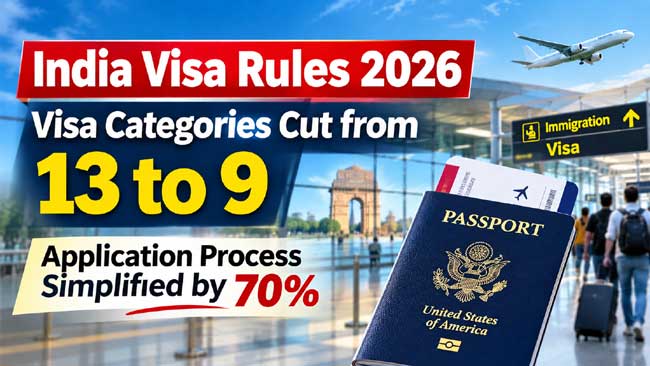
New Delhi, November 12: India Visa Rules 2026 have undergone a major overhaul as the Union Ministry of Home Affairs (MHA) has streamlined the country’s visa system, reducing the number of principal visa categories from 13 to nine and sub-categories from 49 to 23. The government has also reduced the information required in visa application forms by approximately 65 to 70 per cent, aiming to make the process faster, simpler and more accessible to foreign nationals travelling to India.
The Ministry of Home Affairs, in an official announcement issued on November 11, said the rationalisation was undertaken under the leadership of Prime Minister Narendra Modi and the guidance of Union Home Minister Amit Shah. The changes are intended to promote foreign tourist arrivals, medical tourism, international education, business investment and other legitimate travel while improving administrative efficiency in visa processing.
The latest announcement follows a decision taken on August 27, 2026, when the ministry reduced the principal visa categories from 13 to nine and sub-categories from 49 to 23. An earlier exercise in October 2025 had already brought down the number of main categories from 22 to 13 and sub-categories from 63 to 49. The government said it had examined visa systems followed by developed countries and international standards before restructuring India’s existing framework.
The revised system is expected to become operational by the end of 2026, with the Ministry of Home Affairs currently updating its information technology infrastructure to implement the changes. The ministry has clarified that the reforms are designed to eliminate overlapping visa classifications and help applicants identify the appropriate visa according to their purpose of travel.
Tourist Visa Renamed Visitor Visa Under New Rules
One of the most significant changes under India Visa Rules 2026 is the renaming of the existing Tourist Visa as the Visitor Visa, allowing a wider range of short-term and long-term activities under a consolidated framework.
The new Visitor Visa has been divided into two categories, V-1 and V-2. The V-1 visa permits short-duration travel involving tourism, business meetings, medical consultations, wellness retreats, short-term medical treatment and courses in Indian languages, music, arts and crafts. It will be issued for 30 days with multiple-entry facilities.
The V-2 visa is intended for longer stays and may be issued with validity periods of one, five or ten years, depending on eligibility and applicable conditions. It also accommodates mountaineering activities, for which a separate six-month multiple-entry provision has been specified.
The restructuring is particularly relevant to tourism-dependent regions, including Sikkim and other Himalayan destinations, where international visitors travel for leisure, trekking, mountaineering, wellness and cultural experiences. Clearer visa classifications could make it easier for eligible travellers to plan visits, although existing permit requirements and restrictions applicable to protected or restricted areas remain separate considerations.
Medical, Student and Business Visa Provisions Simplified
The revised Medical Visa framework distinguishes between conventional medical treatment and treatment under AYUSH systems. The M-1 category covers medical treatment outside the AYUSH system, while M-3 applies to AYUSH treatment. Both categories, including their electronic visa variants, will generally be issued for one year with multiple entries. Accompanying attendants will be covered under M-2 and M-4 visas, respectively.
For international students, the government has consolidated educational visas into two principal sub-categories. S-1 covers school, undergraduate and postgraduate education, while S-2 accommodates doctoral scholars, researchers, visiting faculty, academic exchanges, internships and other specified research activities. Foreign students admitted through the Study in India portal may obtain an e-S1 visa valid for up to five years or the duration of their academic programme, whichever is shorter.
Business visas have similarly been reorganised into B-1 and B-2 classifications. B-1 will cover longer-term business activities, including establishing industrial or commercial ventures in India, while B-2 will apply to specified short-term contractual assignments, conferences, production investment activities, sports, performing arts and film-related engagements.
The government has also introduced clearer provisions for foreign engineers, technical specialists and other professionals engaged by Indian companies in installation, commissioning, quality assessment, industrial maintenance, technology transfer, training and production support. Eligible professionals may receive visas through the B-2 framework using the electronic visa platform.
Nine Main Visa Categories Under the Revised Framework
The Ministry of Home Affairs has identified the following nine principal visa categories:
| Visa Category | Primary Purpose |
|---|---|
| Business Visa | Business ventures, investment and specified commercial activities |
| Diplomatic Visa | Diplomats, eligible UN diplomats and dependants |
| Work Visa | Long-term employment and specified organisational work |
| Journalist Visa | Journalists accredited in India |
| Medical Visa | Medical treatment, AYUSH treatment and attendants |
| Official Visa | Non-diplomatic government and UN officials |
| Student Visa | Education, research, internships and academic exchanges |
| Visitor Visa | Tourism, short visits, wellness, transit and mountaineering |
| Miscellaneous Visa | Persons of Indian origin, eligible dependants and other specified purposes |
The government has emphasised that the changes are intended to simplify the application process without removing essential information required for scrutiny and security checks. By reducing the number of mandatory fields across all 23 visa sub-categories, the ministry expects applicants to spend less time completing forms while enabling officials to process applications more efficiently.
India currently provides electronic visa facilities to nationals of 172 countries across 13 e-visa sub-categories. The forthcoming implementation of the rationalised framework is expected to provide greater clarity for international visitors, educational institutions, hospitals and businesses seeking to facilitate legitimate travel to India.
The revised India Visa Rules 2026 represent an administrative restructuring rather than an unconditional relaxation of entry requirements. Visa approvals, permitted activities, entry conditions and other applicable regulations will continue to govern foreign nationals visiting the country.
Source: Ministry of Home Affairs, Press Information Bureau, Government of India, November 11, 2026.
PIB Release, 11 Nov 2026