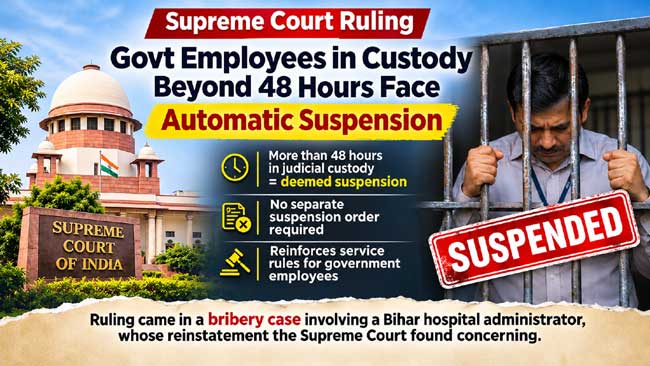
New Delhi, November 10: Supreme Court Government Employee Suspension rules provide that a Central Government employee detained in police or judicial custody for more than 48 hours is automatically deemed suspended from the date of detention under Rule 10(2) of the Central Civil Services (Classification, Control and Appeal) Rules, 1965. In a landmark judgment delivered on July 18, 2003, the Supreme Court of India clarified that such suspension does not automatically end when the employee is released from custody or granted bail, but continues until the competent authority formally modifies or revokes it.
The ruling came in Union of India v. Rajiv Kumar and Bani Singh, involving Civil Appeals Nos. 5007 and 5008 of 2003. A Supreme Court Bench comprising Justice Doraiswamy Raju and Justice Arijit Pasayat, with the judgment authored by Justice Pasayat, examined whether an employee automatically deemed suspended following detention exceeding 48 hours could resume official duties immediately upon release. The Court ruled that release from custody does not automatically terminate the suspension, as the relevant service rules expressly provide for its continuation until further action is taken by the competent authority.
The dispute originated after Rajiv Kumar, a Central Government employee, was arrested on March 26, 1998, for allegedly accepting a bribe. He remained in custody for more than 48 hours before being released on bail on April 2, 1998. Consequently, he was deemed suspended under Rule 10(2), and a subsequent departmental order issued on May 15, 1998, recorded that his suspension would continue until further orders. Kumar challenged the suspension before the Central Administrative Tribunal, and the matter eventually reached the Delhi High Court, which held that deemed suspension remained effective only during the period of detention. According to the High Court, the department would have to issue a fresh suspension order under Rule 10(1) if it intended to keep the employee suspended after release.
However, the Union Government challenged this interpretation before the Supreme Court, arguing that Rule 10(5)(a) clearly provides that any suspension, whether formally ordered or deemed to have been made, remains in force until modified or revoked by the competent authority. Accepting the Government’s argument, the Supreme Court observed that the High Court’s interpretation would undermine the operation of Rule 10(5), which specifically governs the continuation, modification and revocation of suspension orders. The Court further explained that the absence of the expression “until further orders” in Rule 10(2) did not imply that suspension automatically expired upon release from custody.
While examining the Supreme Court Government Employee Suspension provisions, the Bench also addressed concerns regarding prolonged suspension. It acknowledged that keeping an employee suspended unnecessarily for an extended period could have serious consequences, particularly when criminal investigations or departmental proceedings experience substantial delays. Nevertheless, the Court clarified that the duration of suspension alone does not automatically make it unlawful, provided valid reasons exist for its continuation. The judgment reinforced the principle that courts must interpret statutory provisions according to their language rather than introduce conditions that the rules themselves do not prescribe.
The Supreme Court ultimately allowed the Union Government’s appeals and set aside the Delhi High Court’s orders, establishing that government employees covered by the relevant CCS (CCA) provisions who remain in custody for more than 48 hours are deemed suspended from the date of detention and cannot automatically resume their duties merely because they have been released on bail. Their suspension continues until the competent authority formally modifies or revokes it.
Click here To-Go-To Here’s The PDF Link To Judgement
The judgment, delivered on July 18, 2003, remains an important judicial interpretation of deemed suspension under the CCS (CCA) Rules, although its application in individual cases must be considered alongside the applicable service rules and subsequent legal developments.