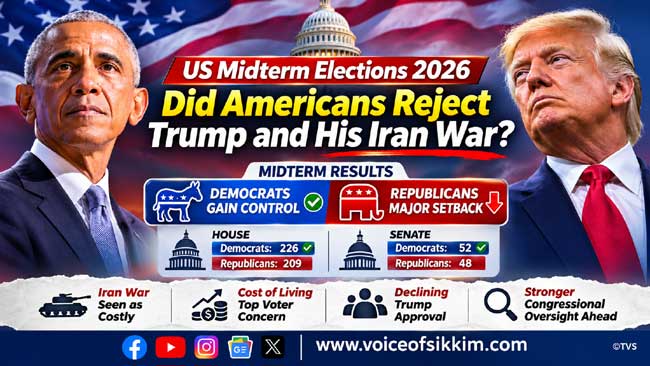
Washington, November 5 : US Midterm Elections 2026 have revealed widespread dissatisfaction with President Donald Trump’s leadership, as Democrats secured control of both chambers of Congress following the November 3 vote. The results have raised important questions about changing American public opinion, particularly over the administration’s handling of the economy, the war with Iran and its broader political agenda.
The Democratic victories, including gains in traditionally Republican states, suggest that dissatisfaction extended beyond established opposition voters. However, election results and voter surveys indicate a combination of economic and political grievances rather than a single nationwide rejection of every Trump administration policy.
A Warning From American Voters
The scale of the Republican setbacks has prompted renewed examination of Trump’s standing among American voters. According to Reuters and Associated Press, Democrats made substantial gains in Republican strongholds, capturing both the House of Representatives and the Senate and significantly changing the balance of political power in Washington.
A Reuters/Ipsos survey conducted shortly before the election found that 48% of people who planned to vote or had already voted viewed their ballot as a vote against Trump, compared with 25% who considered it a vote in his support. Another 25% said the president was not a factor in their decision.
The Associated Press voter survey, involving approximately 80,000 voters, similarly found that around four in ten cast their ballots to oppose Trump, while fewer than two in ten voted to demonstrate support for him. Approximately seven in ten wanted Congress to exercise greater oversight of presidential power.
These findings indicate that opposition to the president was a significant motivation for many voters, although they do not establish that every Democratic vote represented a personal rejection of Trump.
Did Trump’s War With Iran Influence the Election?
One of the most significant questions emerging from the election concerns American attitudes towards the US-Israeli war with Iran, which began in February 2026.
A Reuters/Ipsos survey conducted ahead of the election found that 55% of respondents believed US military action against Iran had not been worth its cost, compared with 25% who considered it worthwhile. The remaining respondents were uncertain.
The findings suggest that the conflict had become politically unpopular among a substantial section of the American electorate. Rising fuel prices, pressure on household budgets and uncertainty surrounding the conflict’s duration contributed to public concerns about the administration’s foreign policy.
Vice President JD Vance also publicly attributed the Republican Party’s electoral setbacks to the Iran war. In remarks reported by TIME and other American media outlets, Vance said the conflict had alienated some voters who supported Trump during the 2024 presidential election.
Nevertheless, the election cannot be interpreted as a direct referendum exclusively on the war. Voters were choosing congressional representatives, and their decisions reflected multiple domestic and international concerns.
Economic Frustration Remained Central
Despite intense attention on the Middle East conflict, economic conditions remained a leading concern among American voters.
The Reuters/Ipsos pre-election survey found that 48% of registered voters identified the cost of living as their most important voting issue, compared with 26% who cited democratic norms and 13% who identified immigration.
The same survey found that 49% of Americans believed their household finances had deteriorated since Trump returned to the White House in January 2025, while only 13% reported improvement.
The connection between foreign policy and domestic economic pressures became particularly significant during the Iran conflict. Disruptions to global energy markets contributed to higher fuel costs, making the consequences of military involvement more visible to American households.
For many voters, dissatisfaction with the war and frustration over living expenses were therefore closely connected rather than entirely separate concerns.
Changing Public Perception of Trump’s Leadership
Public opinion research conducted before the election had already identified a decline in Trump’s approval ratings.
A Pew Research Center survey conducted between September 28 and October 4 found that 30% of American adults approved of Trump’s performance as president, while 68% disapproved. The survey also found that 44% of registered voters viewed their congressional vote as an expression of opposition to Trump, compared with 19% who saw it as a vote supporting him.
The results suggest that dissatisfaction was developing before election day rather than emerging solely from the final vote count.
However, the Republican Party continued to retain substantial support among conservative voters, and Trump’s political influence remained important within the party. The midterm results demonstrate a shift in the electorate’s choices without establishing that his entire political base has abandoned him.
Iran War Becomes a Global Political Question
The American election results have also attracted attention across the Middle East, particularly in Iran, where officials interpreted the Republican defeats as evidence of public opposition to the conflict.
Iranian parliament speaker Mohammad Bagher Qalibaf described the election outcome as a message against war, while other Iranian officials argued that the results demonstrated growing American dissatisfaction with Washington’s military strategy.
Those statements represent the Iranian government’s interpretation of the election rather than an independently established conclusion about the intentions of all American voters.
International observers are also examining how Democratic control of Congress could influence future decisions involving military operations, defence expenditure, sanctions and diplomatic negotiations.
Although Congress possesses important legislative and oversight powers, the president retains significant authority over American foreign policy. Consequently, a change in congressional control does not automatically end the Iran conflict or guarantee a change in Washington’s Middle East strategy.
What the Election Means for Trump’s Remaining Presidency
The Democratic takeover of Congress creates a different political environment for the remaining two years of Trump’s presidential term.
The administration could face stronger congressional scrutiny over military operations, government spending, economic policies and executive decisions. Democratic lawmakers may also seek investigations and greater accountability over the conduct and financial consequences of the Iran war.
Trump, however, continues to hold the presidency and retains constitutional powers, including the ability to veto legislation. Future policy decisions will depend on negotiations between the White House and Congress, as well as developments in the conflict itself.
The results therefore represent a significant change in the balance of political power rather than an immediate transfer of executive authority.
Have Americans Rejected Trump and His War?
The available evidence supports several distinct conclusions.
The election results demonstrate substantial dissatisfaction with the Republican administration, while voter surveys show that opposition to Trump was an important electoral motivation. Separate polling also establishes that a majority of respondents questioned the value of the military campaign against Iran.
However, the evidence does not establish that opposition to the war was the sole or decisive motivation for every voter who supported Democratic candidates. Economic pressures, concerns about democratic institutions and broader dissatisfaction with the administration also shaped the outcome.
The 2026 midterm elections have consequently become an important measure of changing American political sentiment, revealing the combined influence of domestic economic pressures, presidential approval and public concern over prolonged military involvement abroad.
The central political question now is whether the administration and the newly elected Congress will respond to these concerns through changes in economic policy, congressional oversight and America’s approach to the Middle East conflict.