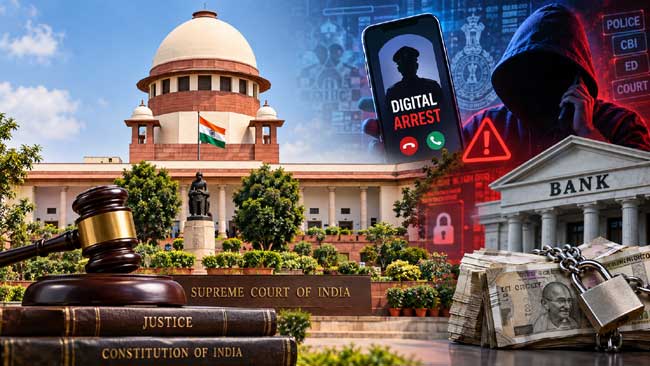
New Delhi, October 29 : The Supreme Court of India has called for banks and financial institutions to compensate victims of digital arrest scams and other cyber frauds when investigations establish that financial losses resulted from a failure to exercise due diligence. The apex court emphasised that compensation in such cases should not be less than the amount lost by the customer, while pressing for stronger banking safeguards to prevent suspicious transactions before money reaches fraudsters.
A three-judge bench comprising Chief Justice of India Surya Kant and Justices Joymalya Bagchi and V. Mohana made the observations on Thursday while hearing suo motu proceedings concerning the growing menace of digital arrest scams. The court stressed that financial institutions must take greater responsibility for protecting customers, particularly when unusually large transactions or suspicious banking activities indicate potential fraud. It maintained that banks cannot escape accountability when negligence in monitoring transactions contributes to financial losses.
The bench directed attention towards the Reserve Bank of India’s proposed Know Your Customer (KYC) Amendment Directions, 2026, which are expected to be notified by November 30 and become operational by December 31. The Supreme Court said the proposed regulatory framework must include provisions requiring financial institutions to compensate victims when failures in due diligence are established. The court also indicated that it could issue further judicial directions if the regulatory measures failed to provide adequate protection.
During the proceedings, the bench highlighted the need for preventive banking mechanisms capable of identifying unusual transactions that differ significantly from customers’ established financial behaviour. It suggested temporarily suspending suspicious transfers, introducing automated reporting systems and conducting physical verification to establish whether transactions are genuine. Banks were also urged to alert nearby police stations when unusual financial activities suggest that customers may be under pressure from cybercriminals.
Chief Justice Surya Kant expressed serious concern over the continued success of digital arrest scams despite extensive public awareness campaigns. Senior advocate NS Nappinai, assisting the court as amicus curiae, informed the bench that such frauds continued to occur and cited a recent incident in which a woman reportedly lost ₹2.5 crore. The court discussed how criminals exploit fear of arrest and misuse the identities of police officers, investigating agencies and judicial authorities to intimidate victims into transferring money.
Attorney General R. Venkataramani informed the court that reported digital arrest cases had declined by approximately 50 per cent compared with the previous year following coordinated preventive measures. However, the Chief Justice observed that financial losses linked to such offences had still reached nearly ₹800 crore during 2026, highlighting the continuing severity of cybercrime. The bench maintained that awareness campaigns alone were insufficient without effective institutional safeguards and enforceable accountability.
The Supreme Court also directed the RBI to submit a list of authorised financial institutions before the next hearing, scheduled for November 30. The court indicated that further directions could apply broadly to regulated financial institutions without requiring every bank to be individually included in the proceedings. Its observations signal a stronger judicial push towards making financial institutions accountable for preventable cyber fraud losses.
The development could have significant implications for banking customers across India, particularly senior citizens and other individuals targeted by digital arrest scams. However, the court’s position does not mean that every cyber fraud victim automatically qualifies for reimbursement. The proposed compensation requirement is linked to establishing that a financial institution’s failure to exercise due diligence contributed to the fraud, with further regulatory and judicial directions still under consideration.