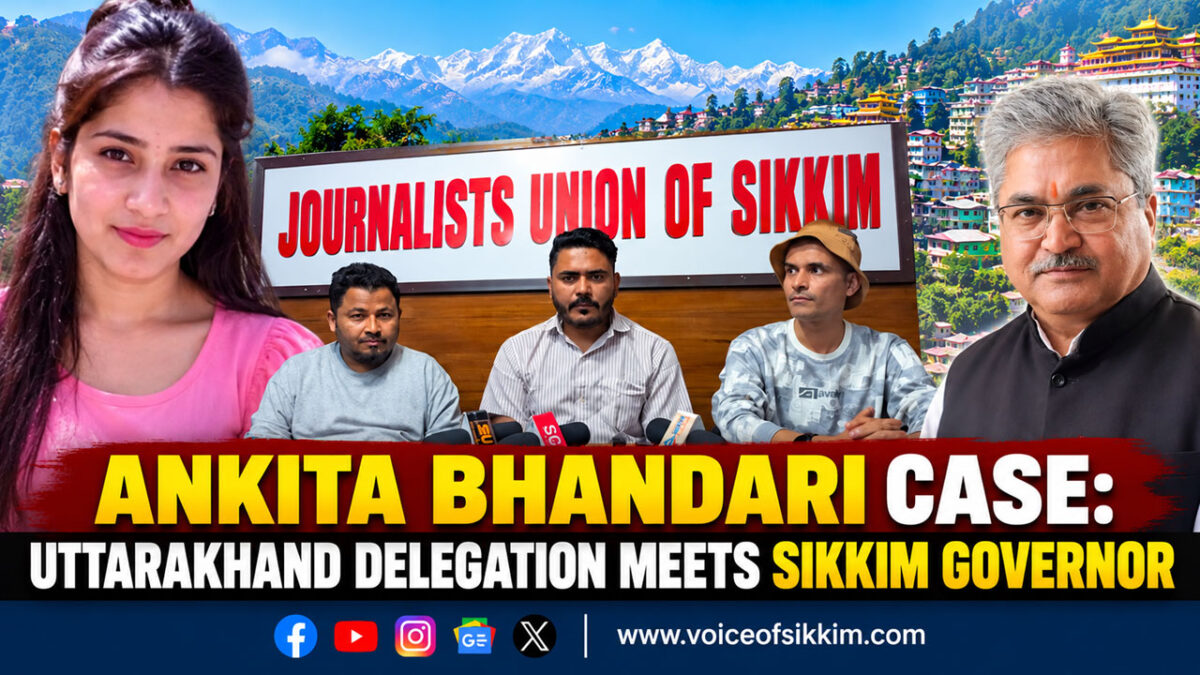
Gangtok, October 20: Uttarakhand Delegation members who travelled approximately 1,500 kilometres from Kotdwar to Gangtok expressed gratitude to the people of Sikkim for supporting the demand for justice in the Ankita Bhandari murder case, while raising questions over the appointment of Dushyant Kumar Gautam as Governor of Sikkim.
Addressing a press conference at the Journalists Union Of Sikkim (JUS) Hall on Monday, October 19, delegation members Ram Kandwal and Shivanand Lakhera acknowledged the support extended by Sikkim’s residents, student organisations and civil society groups. The delegation have been associated with public demonstrations demanding justice for Ankita Bhandari.
Kandwal said the delegation had initially planned to participate in a protest in Gangtok but learned after arriving that the demonstration had been postponed. The visitors consequently decided to convey their message through the press.
Delegation Thanks Sikkim for Solidarity
Speaking at the conference, Kandwal acknowledged the response from Sikkim’s residents, student organisations, civil society representatives and others who had raised concerns over the controversy surrounding Gautam’s appointment.
He said the demonstrations in Sikkim had attracted considerable attention in Uttarakhand, where people had watched videos of the protests circulating on social media.
According to Kandwal, the delegation’s principal purpose was to convey the appreciation of people in Uttarakhand who felt encouraged by the support shown in Sikkim.
He described Ankita Bhandari not only as a daughter of Uttarakhand but also as a daughter of the wider Himalayan region, stressing the need for solidarity among hill states when issues of justice and public accountability arise.
Questions Raised Over Dushyant Gautam’s Appointment
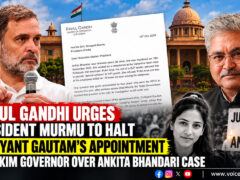
The delegation also questioned the decision to appoint Dushyant Kumar Gautam as Governor of Sikkim while allegations concerning the identity of an alleged VIP in the Ankita Bhandari case continued to generate public controversy.
Kandwal referred to allegations attributed to Bhandari’s parents and argued that the authorities should have waited for the relevant questions to be resolved before proceeding with the gubernatorial appointment.
He also expressed concern over how an investigation involving allegations against a person occupying a constitutional office could proceed.
Lakhera, however, acknowledged that the delegation had no independent knowledge establishing whether Gautam was involved in the matter.
He said the question of any individual’s involvement must ultimately be determined through a lawful investigation and judicial process.
The delegation’s statements concerning Gautam were allegations and questions raised at the press conference, not established findings of wrongdoing. The transcript does not contain evidence establishing Gautam’s involvement in the crime, nor does it include a response from him to the allegations.
‘Justice for Ankita Bhandari’ Committee’s Role
Responding to a question about their relationship with Ankita Bhandari’s family, the delegation clarified that its members were not relatives of the deceased and did not represent a political party.
Kandwal said their involvement arose from a sense of responsibility towards the family and a desire to ensure that the case did not become merely a political issue.
He recalled how a small group initially began demonstrating outside the Kotdwar court during hearings connected with the case.
According to the delegation, the effort gradually attracted public support and led to the formation of the Justice for Ankita Bhandari Committee, under whose banner members continued holding demonstrations during court proceedings.
Lakhera said their objective was not to interfere with the judicial process but to maintain public attention on the case and support the family’s demand for justice.
The delegation also alleged that political affiliations had influenced public responses to the case, arguing that serious crimes should be addressed without regard to the political connections of those involved.
Call for Unity Across Himalayan States
Beyond the Ankita Bhandari case, the visitors used the press conference to raise concerns about the future of Himalayan communities.
Kandwal urged the people of Sikkim to safeguard their land, forests, water resources and employment opportunities, drawing parallels with challenges that he said Uttarakhand was experiencing.
He warned that unchecked exploitation of natural resources and declining local employment opportunities could eventually create similar difficulties in other Himalayan states.
Lakhera spoke about migration from Uttarakhand’s hill districts, citing inadequate educational facilities, healthcare services and livelihood opportunities as major concerns.
He recalled that Uttarakhand was carved out of Uttar Pradesh in 2000 partly to address the distinct geographical, cultural and developmental needs of its hill communities.
Despite differences in language, food and traditions, he said, Himalayan communities share common concerns about their environment, livelihoods and future generations.
The delegation also brought a placard bearing the message “One Himalayan, One Voice”, intended to symbolise solidarity among people living across the Himalayan region.
Appeal to Continue the Campaign
The delegation urged people and civil society organisations in Sikkim to continue supporting the demand for justice in the Ankita Bhandari case.
Its members maintained that their campaign was independent of political parties and was not intended to favour or oppose any particular government.
They appealed for public attention to remain focused on justice for the victim and her family rather than partisan interests.
Concluding the press conference, the delegation reiterated its appreciation to the people of Sikkim, saying their response had strengthened the sense of solidarity between Uttarakhand and Sikkim.
The visitors expressed hope that the cooperation demonstrated over the Ankita Bhandari case would extend to broader concerns affecting Himalayan communities.