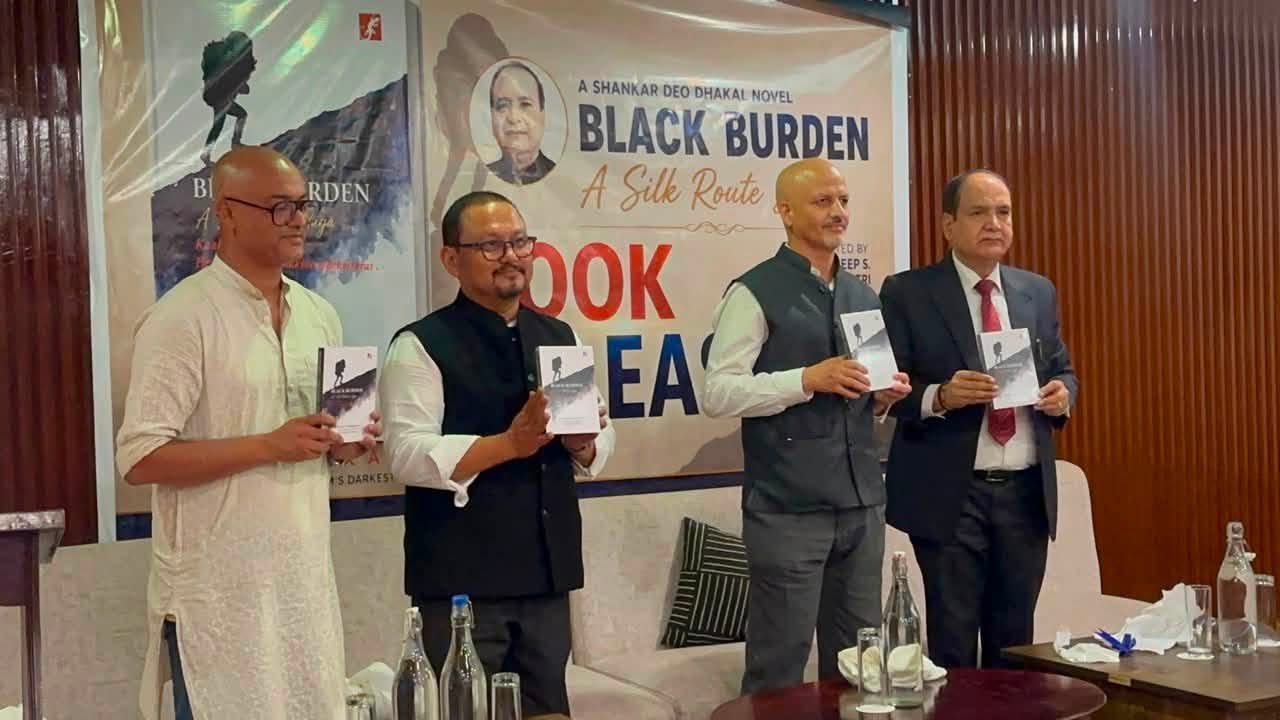
Kalo Bhari Black Button, the English translation of Shanker Deo Dhakal’s Nepali novel, was launched in Gangtok by translator Dr Satyadeep Chettri. Set between 1914 and 1948 British Colonial rule , the novel follows porters who carried loads wrapped in black tarpaulin from Gel Khola, through the foothills of the Teesta and Kalimpong, onward to Tibet along what is today known as the Silk Route.
Gangtok, Aug 24: The Nepali novel Kalo Bhari , written by Shanker Deo Dhakal, has now been made available to English-speaking readers with the release of its translated edition, Black Burden, translated by Dr Satyadeep S. Chettri. Dr Ashish Sharma, Vice-Chancellor of Khangchendzonga State University, attended the launch as a special guest.
Following the release, an interactive session was held with Dhakal, Dr Chettri and moderator Diwakar Basnet, where the discussion covered the origins of the novel, the historical period it portrays, and the challenges of translating an older literary work while retaining its original tone and character.
Responding to a question on the novel’s origins, Dhakal said the story had taken shape over several decades. He explained that the book grew out of his desire to document the hardships endured by porters who transported goods between India and Tibet during the period of British colonial rule and the era of monarchical governance in Sikkim.
Dhakal said he had personally met and spoken with several people who had spent much of their lives working as porters, some of whom were still alive when he carried out his research. These conversations allowed him to preserve their memories, their struggles and their lived experiences within the novel. He added that the book took final shape only after years of sustained research, study and the collection of historical material.
According to Dhakal, Kalo Bhari was never meant to assign blame to any individual or group. Instead, the novel seeks to highlight the social, political and economic conditions that shaped the everyday lives of ordinary people during that period.
Set between 1914 and 1948, the novel follows porters who carried loads wrapped in black tarpaulin from Gel Khola, through the foothills of the Teesta and Kalimpong, onward to Tibet along what is today known as the Silk Route. Their journey did not end upon arrival, as the return leg required carrying salt and wool back across difficult Himalayan terrain. The novel builds these accounts of labour, deprivation and endurance into a wider narrative documenting a long-overlooked chapter of regional history.
Dr Chettri described the translation process as demanding, noting that although the novel is relatively short, its use of literary and older forms of the Nepali language added considerable complexity to the task. He began work on the translation in 2012 and completed the English version nearly twelve years later. He said the greatest challenge lay in finding suitable English equivalents for Sanskrit-derived Nepali terms without losing the original meaning, tone and literary character. Throughout the process, he remained in close coordination with Dhakal, since the English translation required the original author’s approval at every stage.
First published in Nepali in 2009, Kalo Bhari later gained wider recognition after a stage adaptation by the National School of Drama was performed three times at Manan Kendra, introducing the novel and its historical backdrop to a broader Nepali-speaking audience.
Dhakal thanked Dr Chettri for bringing the work to readers beyond the Nepali literary world, noting that while the Nepali edition has already reached a wide readership, the English translation extends that reach to an international audience.
Speakers also explained the reasoning behind the English title. A literal rendering of Kalo Bhari as Black Load or Black Burden, they said, would not adequately convey the novel’s deeper meaning to English readers, prompting the choice of Black Burden as a distinct and more accessible title.
Dr Chettri noted that Black Burden may be the first Nepali novel originating in Sikkim to receive a complete English translation. While the works of writers such as I.B. Rai and Parijat have previously been translated, and short stories from Sikkim have also appeared in translation, he believes this is the first full-length Nepali novel from Sikkim to be rendered into English.
The translated edition is expected to be available shortly on platforms including Amazon, Flipkart and the publisher’s website.
Speakers at the event said the English translation would help introduce Sikkim’s historical labour culture and the broader Himalayan experience to readers worldwide, and stressed that literature can play an important role in recording aspects of history often absent from official accounts. The book was described as an example of subaltern or people’s history, presenting the past through the lives of labourers and ordinary individuals rather than through the perspective of rulers, governments and institutions.
The discussion also referenced Sikkim
From Autocracy to Half Democracy, an earlier work that applied a similar subaltern lens to the state’s history. While that book approached the subject through historical analysis, Black Burden offers a comparable perspective through fiction. One speaker observed that presenting history in literary form could encourage future researchers to study the period more closely, noting that existing historical accounts, while not incorrect, remain incomplete.
The programme further underlined the need for continued research into Sikkim’s political movement of 1946-47, regarded as the first phase of the state’s democratic movement, with speakers noting that much about this period still awaits detailed study and documentation.
With the English release of Black Burden, the memories, struggles and resilience of Sikkim’s former porters are expected to reach audiences beyond the region, offering an international readership a window into a lesser-known chapter of Himalayan history.