The first phase of the Sikkim Nepal flood relief mission will carry medicines, food supplies, solar lights and other essential materials required by flood-affected communities. Preparations are underway, with relief supplies already being loaded into vehicles ahead of the journey.
Gangtok, Aug 29: The Sikkim Nepal flood relief initiative will move into action on August 30, with a medical and humanitarian team scheduled to leave for disaster-hit areas of Nepal carrying medicines, food, solar lights and other essential supplies.
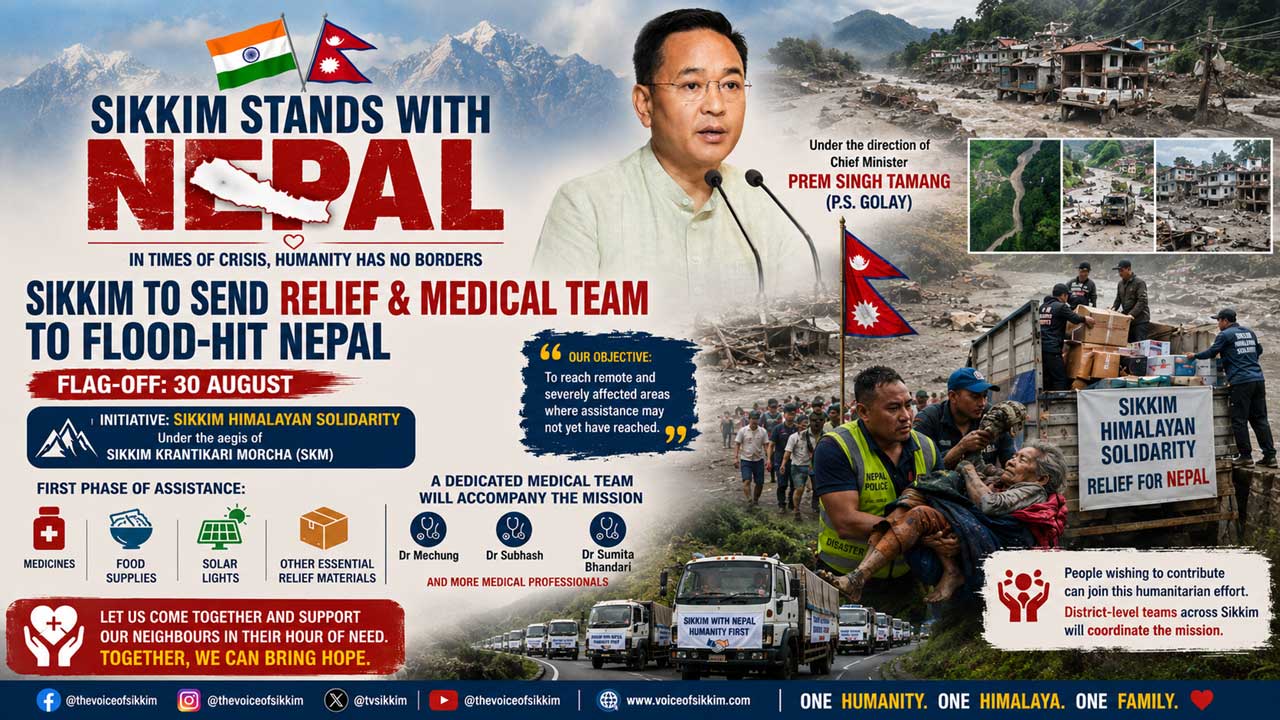
The mission, named “Sikkim Himalayan Solidarity,” is being organised under the aegis of the Sikkim Krantikari Morcha (SKM) following directions from Chief Minister Prem Singh Tamang (P.S. Golay).
Addressing the media, MLA Sanjit Kharel said a meeting was convened on the Chief Minister’s instructions to initiate immediate humanitarian assistance for communities affected by the devastating flash floods in neighbouring Nepal.
According to Kharel, a dedicated team has already been constituted for the relief mission and is scheduled to be flagged off by the Chief Minister from Ridge Park on August 30.
Medicines, Food and Solar Lights to Be Sent
The first phase of the Sikkim Nepal flood relief mission will carry medicines, food supplies, solar lights and other essential materials required by flood-affected communities. Preparations are underway, with relief supplies already being loaded into vehicles ahead of the journey.
A medical team will accompany the humanitarian mission. Kharel said Dr Mechung, Dr Subhash and Dr Sumita Bhandari are among the doctors expected to participate, while more medical professionals may join before the team’s departure.
The mission will focus particularly on remote and severely affected communities where assistance may be difficult to deliver.
Kharel said the Chief Minister had specifically instructed the team to make every possible effort to reach places where relief agencies and assistance may not yet have reached.
“Everyone can reach places that are easily accessible, but our effort will be to reach remote areas where there has been extensive destruction and where people may still be waiting for assistance,” Kharel said.
Experienced Volunteers to Join Mission
Kharel said members of the team have been selected not simply to distribute relief materials but also for their ability to operate in difficult terrain and challenging disaster conditions.
People with previous experience in disaster-response operations, including earthquake relief missions, are also being included in the team.
District-level teams across Sikkim will coordinate the humanitarian initiative, while arrangements are also expected to be made for individuals wishing to contribute towards the relief effort.
Kharel appealed to people across the state to come forward and contribute according to their capacity to support those affected by the disaster.
Sikkim-Nepal Ties Highlighted
Highlighting the longstanding social, cultural and family connections between Sikkim and Nepal, Kharel said families on both sides share close relationships built through marriage, culture and generations of personal ties.
He also recalled the assistance extended by people from Nepal during disasters and difficult periods faced by Sikkim in the past.
“This is also about humanity. When we faced floods and earthquakes, they stood with us. Today, when they are going through such a difficult period, we must stand with them,” Kharel said.
He urged people from all sections of society to unite behind the humanitarian initiative, stressing that natural disasters transcend geographical boundaries and communities must support one another during times of crisis.
Kharel said Chief Minister Prem Singh Tamang had repeatedly emphasised the need for immediate assistance following the disaster and that the current mission was being organised in accordance with his direction.
Preparations for the Sikkim Nepal flood relief mission are now in their final stage. Following its scheduled flag-off on August 30, the team will proceed towards Nepal with medical personnel, volunteers and essential supplies, with priority given to some of the worst-affected and difficult-to-reach communities.