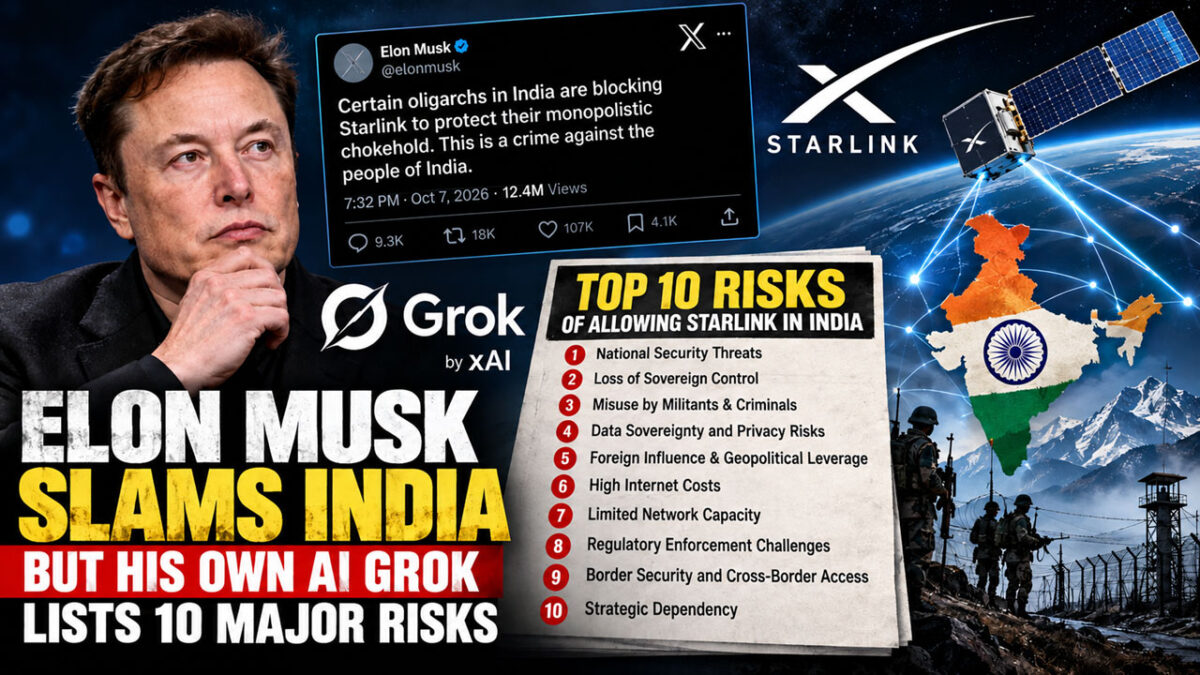
New Delhi, October 15 : Billionaire Elon Musk has accused powerful business interests in India of obstructing the launch of his satellite internet service Starlink, claiming that delays are depriving millions of Indians of affordable high-speed connectivity. However, an assessment generated by Grok, the artificial intelligence assistant developed by Musk’s own company xAI, has highlighted ten potential disadvantages of allowing Starlink to operate in India, including national security threats, data sovereignty concerns, high subscription costs and foreign control over critical communications infrastructure.
The contrasting assessments have brought fresh attention to the debate surrounding Starlink’s proposed entry into the Indian telecommunications market.
In response to a specific question posed by user — “Highlight Top 10 Key Disadvantages of Allowing Starlink In India” — Grok identified a range of potential risks associated with the satellite internet service.
While Grok’s responses do not represent an official position of Elon Musk, SpaceX or xAI, the AI-generated assessment raises questions that closely resemble concerns identified by Indian regulators, security analysts and independent policy researchers.
Musk Accuses Indian Business Interests of Blocking Starlink
On October 7, Musk publicly alleged that influential business interests were preventing Starlink from entering the Indian market to protect their existing dominance over internet services.
In a post on X, Musk accused certain oligarchs of maintaining a “monopolistic chokehold” over Indian consumers and described the situation as a crime against the country’s people.
His remarks came amid continued delays in Starlink’s commercial launch despite the company having obtained a Global Mobile Personal Communication by Satellite licence.
Musk subsequently questioned the influence of Reliance Industries chairman Mukesh Ambani, escalating the dispute over competition and regulatory approvals.
The SpaceX chief argued that Starlink could bring high-speed connectivity to remote and underserved Indian communities, particularly villages lacking reliable mobile or fibre broadband services.
He also maintained that greater competition would benefit Indian consumers.
However, the Indian government rejected suggestions that its regulatory framework favoured particular companies.
Union Communications Minister Jyotiraditya Scindia dismissed allegations of monopolistic interference, while the Ministry of Communications maintained that satellite operators were subject to uniform security and regulatory requirements.
The government clarified that Starlink, Jio Satellite and Eutelsat OneWeb were undergoing security-compliance processes before commercial services could commence.
Grok Identifies 10 Potential Disadvantages of Starlink in India
User’s query to Grok produced an assessment covering ten areas of concern, from strategic dependence on a foreign-controlled satellite constellation to the affordability of satellite internet for ordinary Indian households.
The assessment identified the following potential disadvantages.
1. National Security and Loss of Sovereign Control
One major concern is that SpaceX retains operational control over Starlink’s satellite constellation.
Unlike conventional telecommunications networks, whose domestic infrastructure can be regulated and physically inspected, satellite internet depends on orbital systems and software controlled by the operator.
This could create complications during national emergencies, military operations or government-imposed communication restrictions.
Analysts have cited Starlink’s involvement in the Ukraine conflict as an example of the strategic importance of private satellite communications.
2. Potential Misuse by Militants and Criminal Networks
The reported recovery of Starlink-branded equipment during security operations in Manipur and a narcotics investigation near the Andaman and Nicobar Islands has raised concerns about unauthorised satellite communications.
Portable satellite terminals could potentially allow militant organisations, smugglers and criminal networks to communicate beyond conventional terrestrial networks.
However, the discovery of equipment does not establish that Starlink authorised or knowingly facilitated illegal activities.
3. Data Sovereignty and Privacy Risks
Starlink’s satellite architecture allows information to travel through a global network, including through laser-based inter-satellite links.
Such technology raises questions about how Indian authorities can independently verify that domestic communications remain subject to Indian data protection and lawful interception requirements.
The handling of customer information, including location data and communications-related metadata, has also attracted scrutiny.
4. Dependence on Foreign Technology and Geopolitical Influence
Starlink is operated by SpaceX, an American company subject to US laws and regulatory requirements.
Critics argue that dependence on foreign-controlled satellite infrastructure could expose India to strategic vulnerabilities during international disputes.
Questions remain about the extent to which Indian authorities could independently enforce service continuity, geographical restrictions and operational safeguards.
5. High Internet Subscription and Equipment Costs
Although Musk has presented Starlink as a solution for underserved communities, its potential affordability in India remains uncertain.
Comparisons with neighbouring markets suggest that satellite broadband could cost approximately ₹3,000 to ₹3,500 per month, with additional equipment expenses potentially exceeding ₹20,000.
These are indicative comparisons, not confirmed Indian consumer prices.
Such costs could make Starlink substantially more expensive than existing mobile and fibre broadband services, limiting its usefulness for low-income rural households without subsidies.
6. Limited Satellite Network Capacity
Satellite broadband systems have finite bandwidth and must share available capacity among subscribers within coverage areas.
Consequently, Starlink may initially serve a relatively small proportion of India’s enormous internet market.
The technology could improve connectivity in remote locations but cannot be assumed to replace nationwide terrestrial broadband infrastructure.
7. Challenges in Regulatory Enforcement
India has introduced security conditions covering domestic gateways, lawful interception, geographical restrictions and communications monitoring.
However, verifying compliance across a network of satellites operating in space presents significant technical challenges.
Regulators must ensure that security safeguards are independently enforceable rather than relying exclusively on assurances from satellite operators.
8. Border Security and Cross-Border Connectivity
Satellite coverage does not necessarily follow international borders.
This creates potential complications in sensitive areas adjoining China, Pakistan, Myanmar and other neighbouring countries.
Security agencies may need additional safeguards to prevent unauthorised terminals from accessing satellite networks across geographical boundaries.
Future direct-to-device satellite communications could introduce further regulatory challenges.
9. Operational Reliability and Infrastructure Costs
Starlink terminals require continuous electrical power and suitable sky visibility.
Remote settlements facing frequent power cuts may need batteries, solar installations or other backup systems.
Heavy rainfall, extreme temperatures and physical obstructions can also affect satellite connectivity.
These practical limitations could increase deployment costs in mountainous and disaster-prone regions.
10. Long-Term Digital Sovereignty and Strategic Dependency
The final concern involves India’s long-term dependence on privately controlled foreign communications infrastructure.
Although Starlink could expand connectivity, widespread reliance on a single external operator might create strategic and economic vulnerabilities.
Domestic telecommunications infrastructure, alternative satellite providers and government-supported broadband programmes could help India reduce concentration risks and maintain greater technological autonomy.
Independent Research Raises Similar Concerns
The concerns outlined in Grok’s assessment are not confined to an AI-generated response.
An April 2026 research paper titled Starlink and Risks for India, published by the Takshashila Institution, examined the potential national security implications of Starlink’s operations.
The paper highlighted concerns relating to data usage, SpaceX’s technological capabilities, Elon Musk’s political influence and the difficulty of independently enforcing certain satellite communications security conditions.
It argued that regulatory safeguards may not fully eliminate risks associated with foreign-controlled satellite infrastructure.
The Swadeshi Jagran Manch has also publicly expressed opposition to unrestricted Starlink operations, citing national security and communications monitoring concerns.
These developments suggest that the debate extends beyond commercial rivalry between telecommunications companies.
Starlink Says It Is Ready to Meet India’s Requirements
Despite these concerns, Starlink maintains that its technology can substantially improve internet connectivity in underserved regions.
At India Mobile Congress 2026, SpaceX executive Lauren Dreyer said the company had developed India-specific operational safeguards and invested in domestic ground infrastructure.
According to the company, its preparations include 20 gateway sites with hundreds of antennas and arrangements intended to keep Indian user data within India.
These assurances represent Starlink’s stated position; independent regulatory verification remains important.
India’s Challenge: Connectivity Without Compromising Sovereignty
Satellite internet could provide significant benefits to India’s remote Himalayan settlements, isolated border communities, islands and disaster-prone regions.
For a geographically challenging state such as Sikkim, where mountainous terrain makes conventional telecommunications infrastructure difficult to expand, satellite connectivity could offer an additional communication option.
However, potential benefits must be weighed against affordability, national security, data protection and the ability of Indian authorities to enforce domestic laws.
The contrasting positions of Elon Musk and the Grok-generated assessment underscore the complexity of the issue.
Musk argues that Starlink’s delayed launch is depriving Indians of connectivity and competition. Meanwhile, the AI assistant developed by his own company has identified a series of potential risks that deserve scrutiny.
The Grok assessment is not an admission by Musk or SpaceX that Starlink is unsafe, nor is it an independent technical audit. Nevertheless, its findings provide a useful starting point for examining concerns already being debated by policymakers and security researchers.
Ultimately, India’s decision on Starlink will involve more than internet speed or market competition.
The central question is whether India can expand access to advanced satellite broadband while maintaining enforceable control over its national security, citizens’ data and critical digital infrastructure.