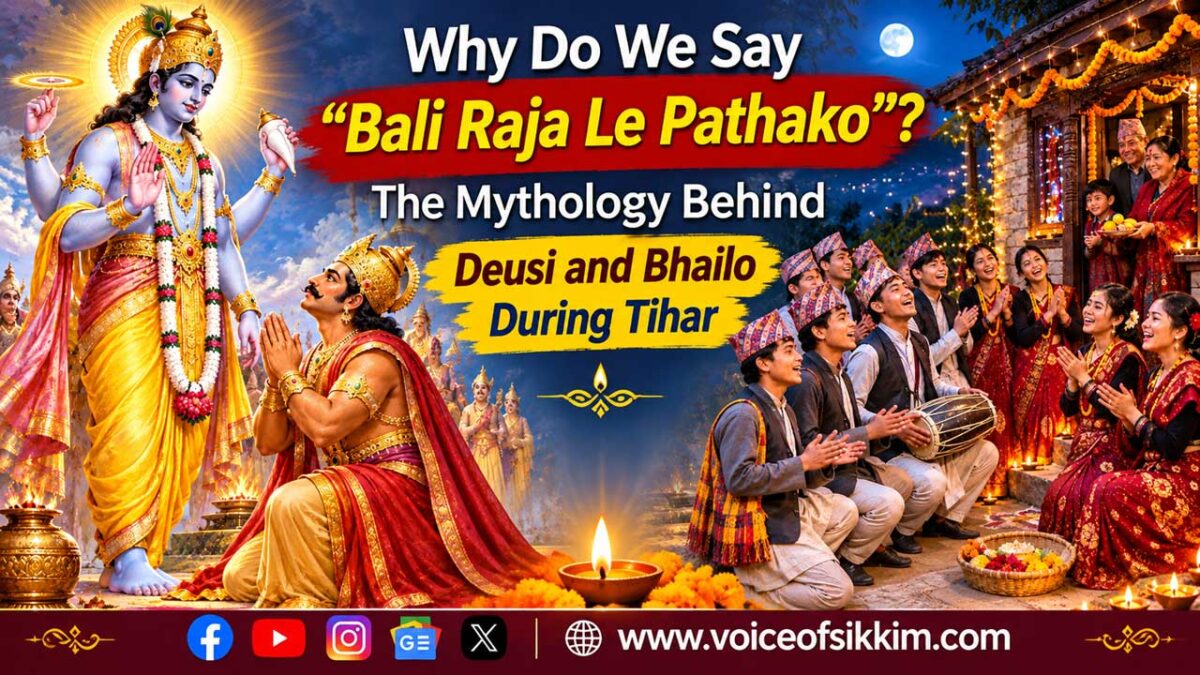
“हामी त्यसै आएनौँ, बलि राजाले पठाको!”
“We have not come on our own; King Bali has sent us!”
Every year during Tihar, the hills and valleys of Nepal, Sikkim, Darjeeling, Kalimpong and other Nepali-speaking regions resonate with the joyous sounds of Deusi and Bhailo. Illuminated homes, glowing oil lamps, colourful decorations and groups of singers moving from one household to another transform ordinary neighbourhoods into vibrant celebrations of faith, generosity and togetherness.
Among the many traditional verses sung during these festivities, one line stands out for its enduring popularity:
“Hami Tesai Aayenau, Bali Raja Le Pathako!”
But who exactly was Bali Raja? Why do Deusi singers invoke his name? And how did the story of an ancient king become associated with one of the most cherished traditions of the Himalayan communities?
The answers lead us into the fascinating world of Hindu mythology, particularly the story of King Mahabali and Lord Vishnu’s Vamana Avatar, while revealing how religious narratives and regional folklore have evolved into a living cultural tradition.
Who Was Bali Raja? The Generous King of Hindu Mythology
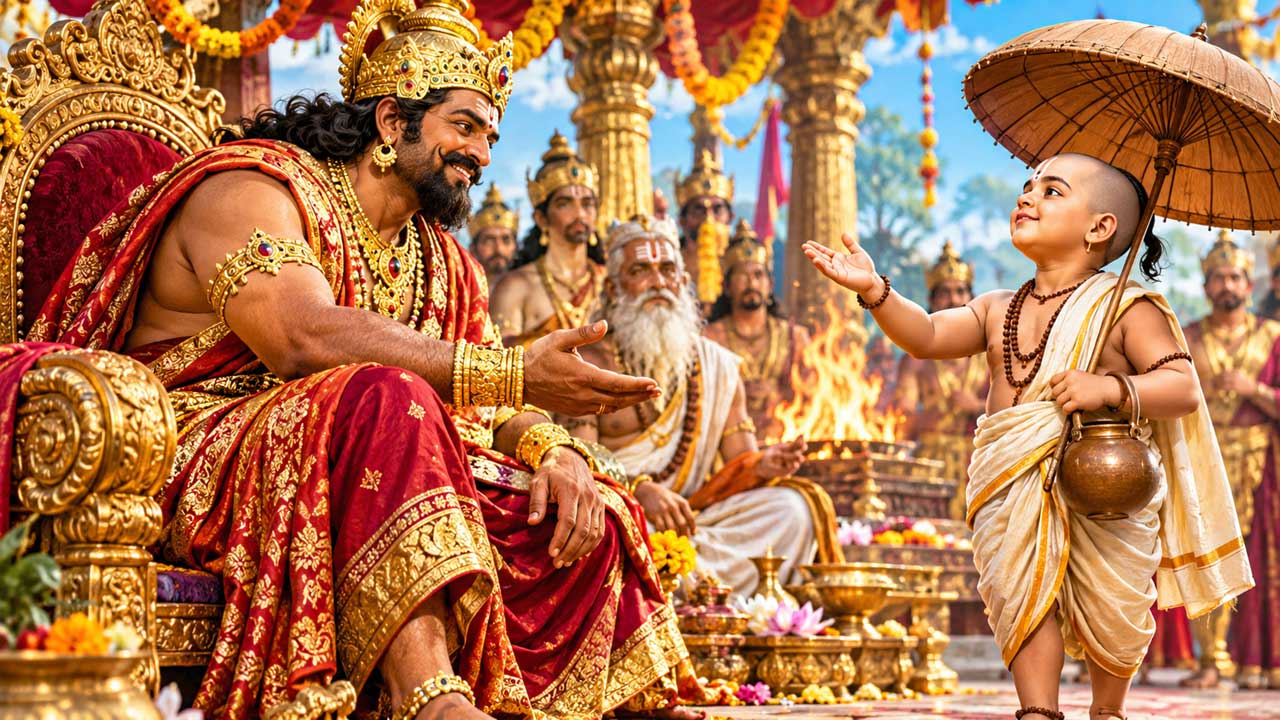
King Mahabali, widely remembered as Bali Raja, occupies a distinctive place in Hindu mythology. Although born into the Asura lineage, he is celebrated in several religious traditions for his generosity, courage, devotion and unwavering commitment to his promises.
According to Hindu scriptures, Mahabali was the grandson of Prahlada, the revered devotee of Lord Vishnu whose unwavering faith forms an important part of the Narasimha Avatar narrative.
Bali inherited a powerful kingdom and gradually extended his influence over the three worlds, traditionally understood as the earthly, celestial and subterranean realms.
His growing authority challenged the position of Indra and the Devas, prompting divine intervention to restore cosmic order.
Yet Bali was not portrayed simply as a conventional villain. His character embodied a profound paradox: a mighty Asura king whose virtues of charity, righteousness and devotion earned him divine recognition.
It was against this backdrop that Lord Vishnu appeared in the form of Vamana, a young Brahmin dwarf, setting the stage for one of Hindu mythology’s most celebrated episodes.
Vamana Avatar: The Three Divine Steps That Changed Bali Raja’s Destiny
The story of Vamana and Mahabali appears in Hindu texts, including the Bhagavata Purana, particularly its Eighth Canto.
According to the narrative, King Bali was conducting a grand sacrificial ceremony when Vamana approached him as a young Brahmin seeking alms.
Renowned for his generosity, Bali welcomed the visitor and offered to grant him whatever he desired.
To the king’s surprise, Vamana requested only three paces of land.
Bali considered the request modest and readily agreed, despite warnings from his spiritual preceptor, Shukracharya, who recognised the visitor’s divine identity.
What followed transformed the meaning of the king’s promise.
The First Step: Measuring the Earth
Vamana began expanding beyond his diminutive appearance, assuming the immense cosmic form known as Trivikrama.
In traditional retellings, his first stride encompassed the earthly realm.
The Second Step: Encompassing the Heavens
With his second stride, Vishnu extended across the celestial regions, demonstrating that the entire universe existed within his divine power.
Having measured everything with two steps, Vamana asked Bali where he should place the third.
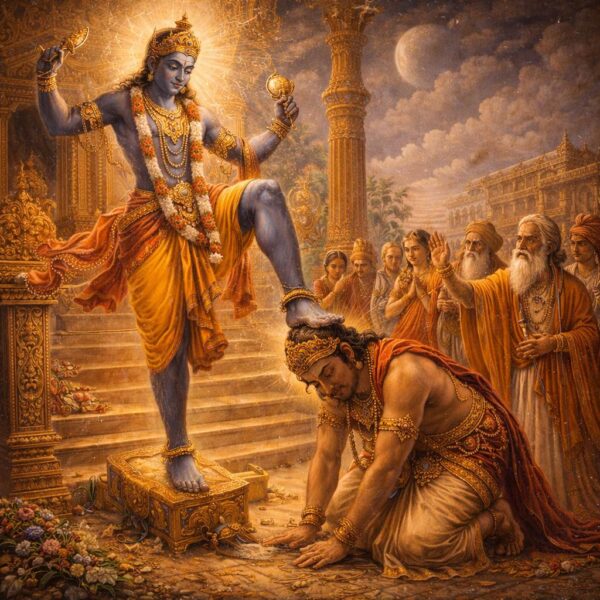
The Third Step: Bali Offers His Own Head
Unable to provide any remaining territory, Bali chose to honour his promise through an extraordinary act of surrender.
He bowed before Lord Vishnu and offered his own head for the final step.
In essence, his response was:
“My Lord, place your third step upon my head.”
This moment is central to the story’s spiritual significance.
Bali surrendered not merely his possessions but also his pride and claim to worldly sovereignty. His willingness to keep his word, even when confronted with the loss of everything he controlled, transformed him into a lasting symbol of humility, devotion and integrity.
The narrative illustrates a timeless religious principle: genuine greatness lies not simply in possessing power or wealth, but in recognising a higher moral responsibility.
Did Lord Vishnu Grant Bali Raja Permission to Return Every Year?
One of the most widely repeated explanations for the Deusi-Bhailo tradition is that Lord Vishnu granted King Bali permission to return to earth once every year to visit his subjects.
Although this belief is deeply embedded in popular festival narratives, an important distinction must be made between scriptural accounts and regional folklore.
In the Bhagavata Purana, Vishnu rewards Bali’s devotion by granting him rulership over Sutala, a magnificent subterranean realm, and assuring him of divine protection.
The tradition of Mahabali returning annually to visit his people is especially prominent in Kerala’s Onam celebrations, where he is remembered as an ideal and benevolent ruler.
Nepali Deusi-Bhailo traditions also preserve the name of Bali Raja, but the precise historical relationship between these customs and the Vamana narrative is not established by a single universally accepted scriptural account.
Regional oral traditions have developed different explanations for why Bali’s name is invoked during Tihar.
Therefore, the belief that Deusi singers are personally sent by King Bali should be understood as a cherished folk interpretation rather than a historically verified event or a universal scriptural teaching.
This distinction does not diminish the cultural importance of the tradition. Instead, it demonstrates how communities preserve and reinterpret ancient religious narratives through music, ritual and collective memory.
Why Do Deusi Singers Say “Bali Raja Le Pathako”?
The familiar phrase “Bali Raja Le Pathako” translates approximately to “King Bali has sent us.”
In a popular Nepali folk interpretation, Deusi singers symbolically represent messengers of the generous king.
Their arrival at a household is understood as more than an ordinary musical performance. They bring festive greetings, goodwill, blessings and wishes for the family’s prosperity.
When singers proclaim:
“हामी त्यसै आएनौँ, बलि राजाले पठाको!”
They are effectively announcing:
“We have not come without a purpose. We have come carrying the blessings and goodwill associated with King Bali.”
The symbolism becomes particularly meaningful when viewed through the story of Mahabali.
Just as the legendary king was celebrated for his generosity, the Deusi-Bhailo tradition encourages households to practise hospitality and charitable giving.
The visiting groups offer songs and blessings, while the hosts respond with food, sweets, gifts and customary financial offerings known as Dakshina.
This reciprocal exchange transforms the celebration into a communal expression of generosity.
The singers do not merely entertain. They participate in a tradition that reinforces relationships, creates shared happiness and preserves the moral values associated with Bali Raja.
What Does “Deusi Re” Mean? Exploring the Traditional Refrain
Another intriguing aspect of the festival is the familiar chorus:
“Deusi Re! Deusi Re!”
The expression is central to Deusi performances, yet its precise linguistic origin remains uncertain.
Several explanations circulate within popular oral traditions.
One interpretation associates the expression with “Deva Sri”, suggesting divine glory, auspiciousness or reverence.
Another folk explanation connects it with “Deo Sira”, symbolically relating the expression to Bali offering his head before Lord Vishnu.
However, these proposed derivations are not universally established by linguistic or historical scholarship.
They should therefore be regarded as traditional interpretations rather than definitive etymological explanations.
What is unmistakable is the refrain’s musical and cultural importance.
During a Deusi performance, a lead singer recites or improvises verses, while the accompanying group responds rhythmically with “Deusi Re!”
This call-and-response format creates a lively atmosphere, allowing singers, dancers and householders to participate in a shared celebration.
The words have become so deeply associated with Tihar that their sound alone evokes the warmth and excitement of the festival.
Deusi and Bhailo: Understanding the Difference
Although Deusi and Bhailo are often mentioned together, the two traditions have historically featured differences in performance, participation and customary timing.
| Tradition | Deusi | Bhailo |
|---|---|---|
| Traditional participants | Often boys and men | Often girls and women |
| Customary timing | Frequently associated with the later days of Tihar | Frequently associated with Lakshmi Puja |
| Musical style | Energetic call-and-response chanting | Melodious group singing |
| Familiar refrain | “Deusi Re!” | “Bhailini Aayin Aangana!” |
| Central purpose | Blessings, goodwill and celebration | Blessings, prosperity and celebration |
These distinctions vary across communities and are not rigid rules. Contemporary celebrations frequently involve mixed groups of children, young people and adults participating in both forms.
The Role of the Lead Singer: Bhatyaune
A distinctive feature of Deusi is the role of the lead performer, who recites verses, introduces the group, praises the household and prompts the accompanying singers to respond.
This traditional style is commonly known as Bhatyaune.
The lead singer may begin with a rhythmic call such as:
“Aahai Bhana Mera Bhai Ho!”
The chorus then responds enthusiastically:
“Deusi Re!”
The expression roughly invites fellow performers to join in the response.
Through improvisation, humour, blessings and rhythmic chanting, Bhatyaune transforms the performance into an interactive cultural experience.
How Households Welcome Deusi-Bhailo Singers During Tihar
Across Nepal and Nepali-speaking communities of Sikkim and the Darjeeling hills, welcoming Deusi-Bhailo performers remains an important part of festive hospitality.
Families often decorate their entrances with marigold garlands, traditional oil lamps, colourful lights and rangoli patterns.
When performers arrive, householders gather to listen to the songs and receive blessings for peace, prosperity, good health and happiness.
Customary offerings may include sel roti, fruits, sweets, walnuts, other festive foods and Dakshina.
Sel roti, a traditional ring-shaped rice preparation, holds particular significance in Nepali festive cuisine.
The offerings vary according to local customs, family circumstances and community practices.
Importantly, the exchange is not simply a transaction between performers and householders. It represents a shared celebration in which both groups contribute to the festive atmosphere.
The performers bring music, blessings and joy, while the householders express appreciation through hospitality and generosity.
Deusi-Bhailo in Sikkim and the Eastern Himalayas
For Nepali-speaking communities across Sikkim, Darjeeling, Kalimpong and neighbouring Himalayan regions, Deusi-Bhailo represents far more than seasonal entertainment.
It is a living expression of cultural identity, community participation and intergenerational heritage.
During Tihar, groups of children, youths and community organisations move through neighbourhoods, singing traditional verses and performing dances.
In some places, organised Deusi-Bhailo programmes also help raise funds for community activities, social causes and cultural initiatives.
The tradition brings together families and neighbours, encourages younger generations to learn traditional songs and helps preserve the Nepali language through oral performance.
Its continued popularity illustrates the resilience of Himalayan cultural traditions, even as lifestyles, musical preferences and social environments evolve.
Modern performances may incorporate contemporary instruments, choreography and musical arrangements, but the essential spirit remains recognisable.
At its heart, Deusi-Bhailo continues to celebrate the simple yet powerful act of visiting one another, sharing goodwill and strengthening community bonds.
How Bali Raja’s Story Connects Mythology, Generosity and Community
The enduring appeal of Bali Raja’s story lies in its moral depth.
Mahabali possessed immense power, yet his most celebrated act was not a military conquest or the expansion of his kingdom.
It was his decision to honour a promise.
When confronted with Lord Vishnu’s divine form, he chose humility over pride and devotion over personal possession.
In the Deusi-Bhailo tradition, these values find a cultural expression through the exchange of blessings and offerings.
The household becomes a place of welcome. The singers become carriers of goodwill. The celebration becomes an opportunity to practise generosity.
This is how mythology can continue to influence everyday life—not necessarily through literal reenactment of ancient events, but through the values communities associate with them.
The Timeless Legacy of Bali Raja During Tihar
Every Tihar, the familiar call of “Bali Raja Le Pathako” carries generations of cultural memory into illuminated courtyards and welcoming homes.
The phrase connects the mythological figure of King Mahabali with the warmth of Nepali festive traditions, even though the precise origins of that association remain part of regional folklore.
It reminds communities that wealth is meaningful when shared, that promises carry moral responsibility and that generosity can create bonds stronger than power or status.
The story of Bali Raja continues to inspire not because his kingdom survives in a historical record, but because the ideals associated with his character remain relevant.
And when the Himalayan hills once again echo with:
“हामी त्यसै आएनौँ, बलि राजाले पठाको!”
The words carry more than a festive announcement.
They celebrate an ancient king remembered for generosity, a community united through music and a cultural tradition sustained by the joy of giving.
Every Tihar, Bali Raja’s legacy comes alive—not upon a royal throne, but through shared blessings, illuminated homes and the welcoming hearts of ordinary people.
Frequently Asked Questions About Bali Raja and Deusi-Bhailo
1. Why do Deusi singers say “Bali Raja Le Pathako”?
According to a popular Nepali folk interpretation, Deusi singers symbolically represent messengers of King Bali, bringing blessings and goodwill to households during Tihar. This association belongs to regional oral tradition rather than a universally established scriptural account.
2. What is the difference between Deusi and Bhailo?
Deusi has traditionally been associated with male groups and energetic call-and-response chanting, while Bhailo has often been performed by female groups with melodic folk songs. Customs vary by region, and modern celebrations commonly involve mixed groups.
3. Did Lord Vishnu allow King Bali to return to earth every year?
The annual return of King Mahabali is a prominent belief associated with Kerala’s Onam festival and appears in various regional traditions. The Bhagavata Purana describes Vishnu granting Bali rulership of Sutala and divine protection. The connection between Bali’s annual return and Deusi-Bhailo should be treated as folklore rather than a universally established scriptural account.
4. What do families offer Deusi-Bhailo performers?
Families commonly offer sel roti, fruits, sweets, festive food and Dakshina. Offerings vary according to local traditions and household customs.
5. What does “Aahai Bhana Mera Bhai Ho” mean?
The phrase roughly means “Come, say it, my brothers!” It is a traditional prompt used by the lead singer to encourage the group to respond together with the refrain “Deusi Re!”
6. What is the meaning of “Deusi Re”?
“Deusi Re” is the rhythmic chorus associated with traditional Deusi performances. Several folk explanations exist for its origin, but its precise linguistic derivation remains uncertain.
Cultural and editorial note: The Vamana–Mahabali narrative is rooted in Hindu scriptural traditions, while explanations linking Bali Raja to Deusi-Bhailo are largely preserved through regional folklore. Interpretations vary between communities and should not be presented as a single historically verified origin.