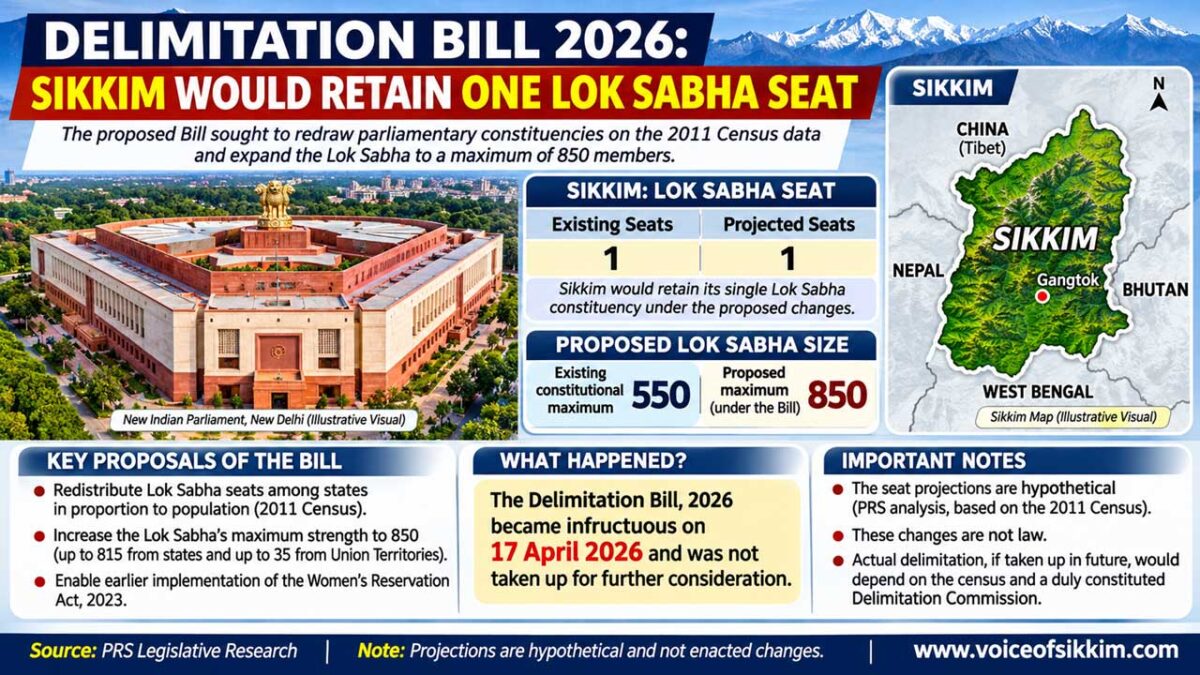
New Delhi, 28 November : The Delimitation Bill 2026 proposed a significant restructuring of India’s parliamentary constituencies, seeking to increase the maximum strength of the Lok Sabha from 550 to 850 members and redistribute parliamentary seats among states based on population figures from the 2011 Census.
The Bill was introduced in the Lok Sabha on 16 April 2026, alongside the Constitution (131st Amendment) Bill, 2026 and the Union Territories Laws (Amendment) Bill, 2026. According to PRS Legislative Research, the Delimitation Bill was listed as infructuous on 17 April 2026.
Although the proposed legislation did not proceed, it highlighted the potential implications of parliamentary restructuring for states across India, including Sikkim, and raised questions regarding regional representation, women’s reservation and the balance of parliamentary power.
What is delimitation?
Delimitation is the process of redrawing the boundaries of Lok Sabha and State Legislative Assembly constituencies to ensure broadly proportionate population representation.
The allocation of parliamentary seats among states has remained frozen on the basis of the 1971 Census. The constitutional freeze, introduced in 1976, was subsequently extended until the first census conducted after 2026 to encourage states to undertake population control measures without losing parliamentary representation.
What did the Delimitation Bill 2026 propose?
The proposed legislation sought to increase the maximum strength of the Lok Sabha to 850 members, comprising up to 815 representatives from states and 35 from Union Territories.
It also proposed empowering Parliament to determine the timing of delimitation and the census figures to be used for the exercise. Under the proposed Bill, the latest published census figures, currently those from 2011, would have formed the basis for redistribution.
A Delimitation Commission headed by a serving or former Supreme Court judge would have been constituted by the Central Government to undertake the exercise.
How would parliamentary seats have changed?
According to projections prepared by PRS Legislative Research, redistribution based on the 2011 Census could have significantly altered the parliamentary representation of several states.
Projected Lok Sabha Seat Redistribution
Scenario: Existing Lok Sabha strength retained at 543 seats.
| State | Existing Seats | Projected Seats | Change |
|---|---|---|---|
| Uttar Pradesh | 80 | 89 | +9 |
| Bihar | 40 | 46 | +6 |
| Tamil Nadu | 39 | 32 | -7 |
| Rajasthan | 25 | 30 | +5 |
| Kerala | 20 | 15 | -5 |
| Sikkim | 1 | 1 | 0 |
Source: PRS Legislative Research.
These figures represent hypothetical seat allocations based on the 2011 Census, not enacted changes.
Under another scenario involving an approximately 50 per cent expansion of the Lok Sabha, Uttar Pradesh could have received 133 seats, Bihar 69 and Maharashtra 75.
Sikkim would retain its single Lok Sabha seat
Of particular significance to Sikkim, the PRS analysis indicated that the Himalayan state would retain its existing single Lok Sabha constituency under both projected scenarios.
However, an expansion of the overall strength of the Lok Sabha without a corresponding increase in Sikkim’s representation would reduce the state’s proportionate share in the Lower House.
Women’s reservation and the 2029 elections
The proposed legislation was also intended to facilitate the implementation of the Women’s Reservation Act, 2023, which provides for one-third reservation for women in the Lok Sabha and State Legislative Assemblies.
Under the existing constitutional framework, women’s reservation is linked to a delimitation exercise following the first census conducted after the enactment of the legislation.
With the upcoming census having a reference date of 1 March 2027, completing the delimitation process before the 2029 general elections could prove challenging.
The proposed Bills sought to remove this dependency and facilitate earlier implementation of women’s reservation.
Concerns raised by PRS Legislative Research
PRS highlighted several constitutional and parliamentary concerns associated with the proposed reforms.
Empowering Parliament to determine the timing of delimitation and the census figures through a simple majority could give the government of the day greater control over the exercise.
With the Rajya Sabha’s maximum strength remaining at 250 members, an expanded Lok Sabha would also alter the balance between the two Houses. The ratio of Lok Sabha to Rajya Sabha members could increase from approximately 2.2:1 to 3.3:1, affecting their relative influence in presidential and vice-presidential elections and joint parliamentary sittings.
Under the existing constitutional ceiling of 15 per cent on the size of the Council of Ministers, an increase in Lok Sabha membership to 815 could allow the number of ministers to rise from 81 to 122.
PRS also highlighted concerns over reduced opportunities for individual MPs to participate in parliamentary debates and raise questions.
What happened to the Delimitation Bill?
On 17 April 2026, the Constitution (131st Amendment) Bill failed to secure the requisite special majority in the Lok Sabha, with 298 members voting in favour and 230 against.
Consequently, the two associated Bills, including the Delimitation Bill 2026, became infructuous and were not taken up for further consideration.
The proposed redistribution of parliamentary constituencies and expansion of the Lok Sabha therefore did not become law.
Source: PRS Legislative Research – Delimitation Bills of 2026