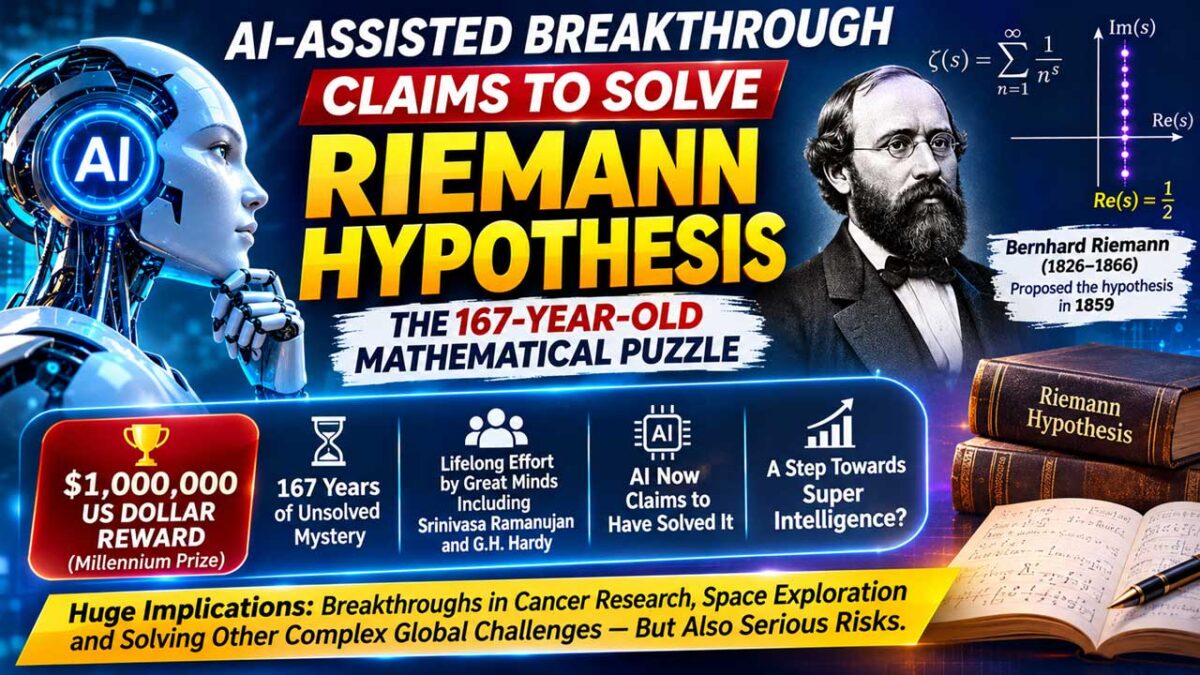
First proposed in 1859 by German mathematician Bernhard Riemann, the hypothesis has remained one of the most significant challenges in modern mathematics for over 167 years. Renowned mathematicians, including Srinivasa Ramanujan and G.H. Hardy, made substantial contributions to research involving prime numbers and related mathematical theories.
The Riemann Hypothesis concerns the intricate mathematical patterns governing the distribution of prime numbers. A verified solution could have profound implications for number theory and mathematical research.
The reported breakthrough has also raised questions about whether humanity is approaching artificial superintelligence, a theoretical stage at which machines could surpass human intellectual capabilities across virtually every field.
Artificial Intelligence: Opportunities and Risks
Advanced AI systems could potentially accelerate scientific discoveries, cancer research, drug development, space exploration and engineering, helping humanity address challenges that have remained unresolved for generations.
However, increasingly powerful AI systems also raise concerns regarding technological control, human safety, accountability and the future of civilisation. Developing effective safeguards and maintaining human oversight will remain essential as the technology advances.
While the AI Riemann Hypothesis claim represents a potentially significant development, it must undergo rigorous independent mathematical scrutiny before being recognised as an established scientific breakthrough.