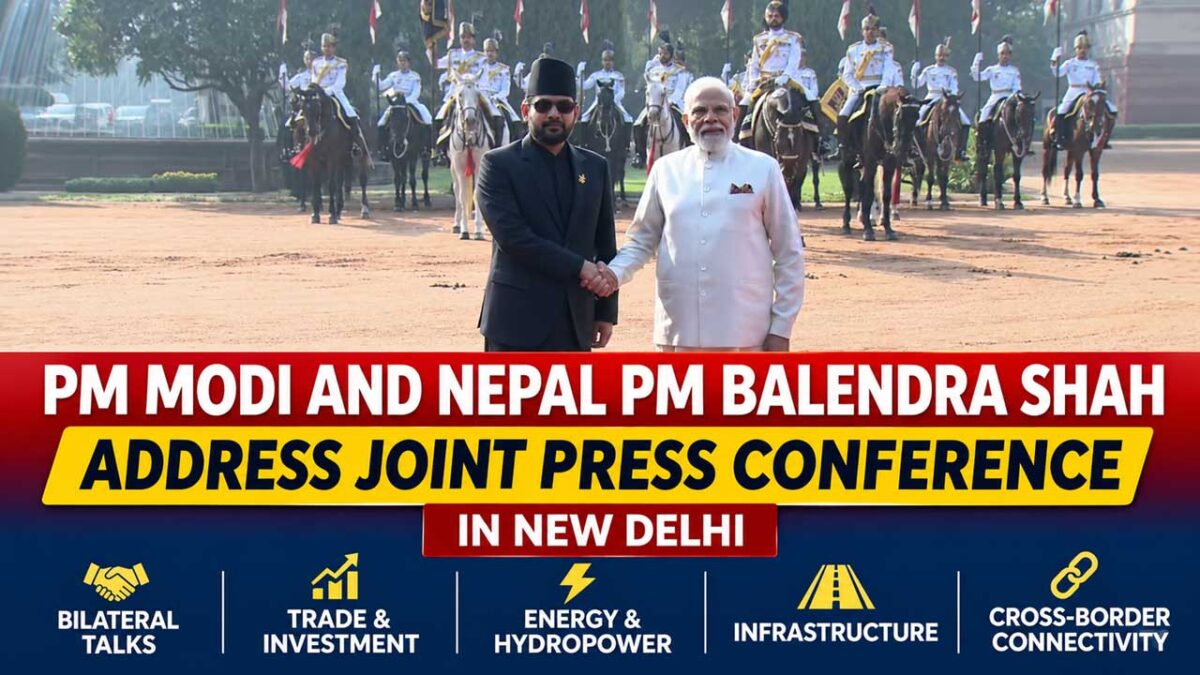
The announcements came during Shah’s official visit to India, with the two Prime Ministers holding discussions on economic cooperation, infrastructure development, energy security, trade and regional connectivity.
The newly launched Saryu–Kamala Express is expected to facilitate religious tourism between Ayodhya, associated with Lord Ram, and Janakpur, traditionally regarded as the birthplace of Goddess Sita. Modi said the service would deepen the longstanding spiritual relationship between the neighbouring countries while making pilgrimage travel more convenient.
Both leaders also emphasised improving connectivity between major Buddhist and Hindu pilgrimage destinations, including Lumbini in Nepal and Bodh Gaya in India.
In another major development, Modi and Shah inaugurated the Dharchula Road Bridge connecting Uttarakhand with Nepal and laid the foundation stone for an Integrated Check Post at Banbasa. India also committed to accelerating work on the Dodhara Chandani Integrated Check Post on the Nepalese side, with the projects intended to improve the movement of people and goods across the border.
On trade and economic cooperation, Modi announced that India would provide Nepal access to the ports of Kandla and Paradip, potentially expanding transit opportunities for the landlocked Himalayan nation. The initiative is expected to support Nepal’s international trade and strengthen its access to maritime routes.
Energy cooperation featured prominently in the bilateral discussions. The two leaders marked the foundation stone laying for the Lower Arun Hydroelectric Project, while India reiterated its commitment to completing the Arun-III hydropower project on schedule.
Modi highlighted Nepal’s substantial hydropower potential and India’s large energy market, describing cooperation in the sector as an important opportunity for Nepal’s economic development.
The two countries also advanced petroleum infrastructure cooperation through the inauguration of the second phase of the Motihari–Amlekhganj petroleum pipeline and the foundation stone laying for the Jaipa Petroleum Terminal. These initiatives are aimed at strengthening Nepal’s energy supply infrastructure and improving fuel distribution.
During the discussions, Modi reaffirmed India’s commitment to supplying petroleum products, fertilisers and other essential commodities to Nepal, citing New Delhi’s continued support despite disruptions in global oil supplies during the year.
India and Nepal also released a Joint Vision Document outlining priorities for future bilateral cooperation. Modi described the document as a roadmap linking India’s Viksit Bharat aspirations with Nepal’s vision of Samunnat Nepal, or a prosperous Nepal.
The developments underline efforts by both governments to strengthen their longstanding relationship through infrastructure investment, economic integration, religious tourism and energy cooperation.
The NPR 24,000 crore development package, alongside the newly announced connectivity and infrastructure initiatives, represents a substantial commitment towards advancing bilateral cooperation between India and Nepal.