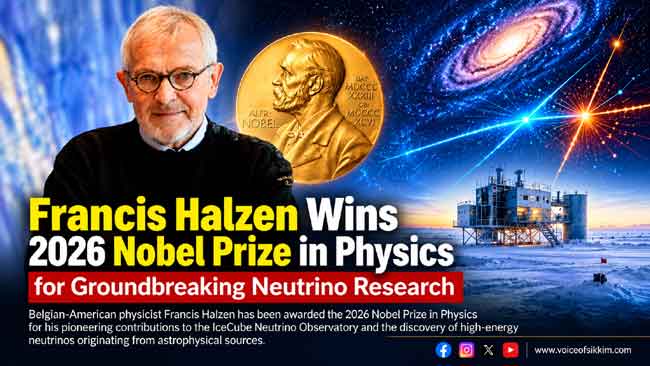
Stockholm, October 6: Belgian-American physicist Francis Halzen has been awarded the 2026 Nobel Prize in Physics for his pioneering contributions to the IceCube Neutrino Observatory and the discovery of high-energy neutrinos originating from astrophysical sources.
The Royal Swedish Academy of Sciences announced the award on Tuesday, recognising Halzen “for decisive contributions to the IceCube Neutrino Observatory and the discovery of high-energy neutrinos of astrophysical origin.”
Halzen is a professor at the University of Wisconsin–Madison and the principal investigator of the IceCube Neutrino Observatory, a major scientific facility located deep beneath the Antarctic ice at the South Pole. His scientific leadership played a key role in the development of the observatory.
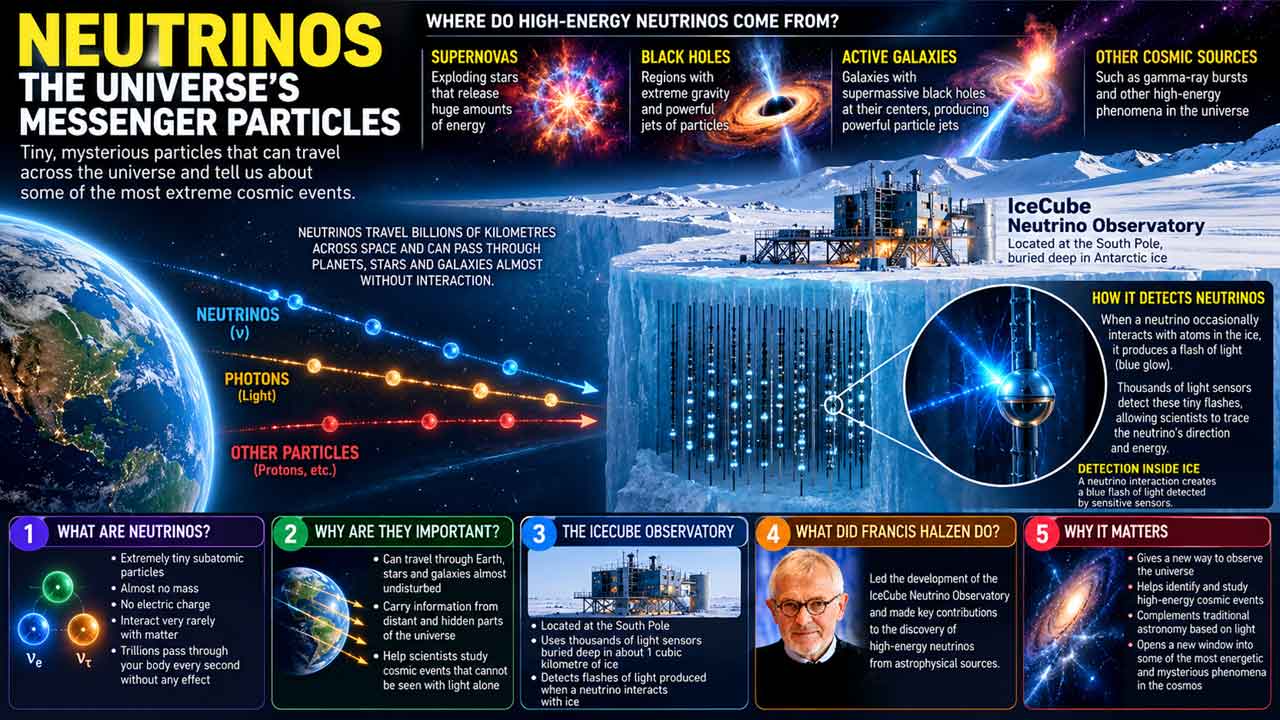
IceCube uses thousands of light sensors embedded within approximately one cubic kilometre of Antarctic ice to detect neutrinos, extremely elusive subatomic particles that can travel enormous distances through the universe while rarely interacting with matter.
The observatory has enabled scientists to detect high-energy neutrinos from astrophysical sources, providing researchers with a new way to study some of the most energetic and mysterious phenomena in the universe.
The 2026 Nobel Prize carries a cash award of 12 million Swedish kronor, valued at approximately Rs 11.5 crore in Indian currency. Halzen is the sole recipient of this year’s Nobel Prize in Physics.
The discovery has helped establish neutrinos as important cosmic messengers, giving scientists another way to explore the universe alongside observations using light and other forms of electromagnetic radiation.
Neutrinos: The Mysterious ‘Ghost Particles’ Helping Scientists Explore the Universe
Neutrinos are among the smallest and most mysterious particles known to science, yet they are helping researchers understand some of the most powerful events occurring across the universe.
Often described as “ghost particles,” neutrinos have no electric charge and interact extremely weakly with ordinary matter. Enormous numbers of them pass through the Earth — and even through our bodies — every second without causing any noticeable effect.
Some high-energy neutrinos reaching Earth originate from distant astrophysical environments. Because neutrinos can travel vast distances while passing through matter almost undisturbed, they can carry valuable information about places in the universe that are difficult to study using light alone.
Detecting them, however, is extremely challenging.
The IceCube Neutrino Observatory at the South Pole tackles this problem using thousands of highly sensitive light detectors embedded deep within Antarctic ice. When a neutrino occasionally interacts with matter in or near the ice, the resulting charged particles can produce a faint flash of blue Cherenkov light. IceCube’s sensors record these signals, allowing scientists to reconstruct information about the neutrino’s direction and energy.
This emerging field is known as neutrino astronomy.
By studying these cosmic messengers alongside light, gravitational waves and other signals, scientists can build a more complete picture of extreme phenomena in the universe.
In simple terms, neutrinos are giving humanity another way to explore the cosmos — not simply by looking at the universe, but by detecting particles that have travelled across it carrying clues about where they came from.