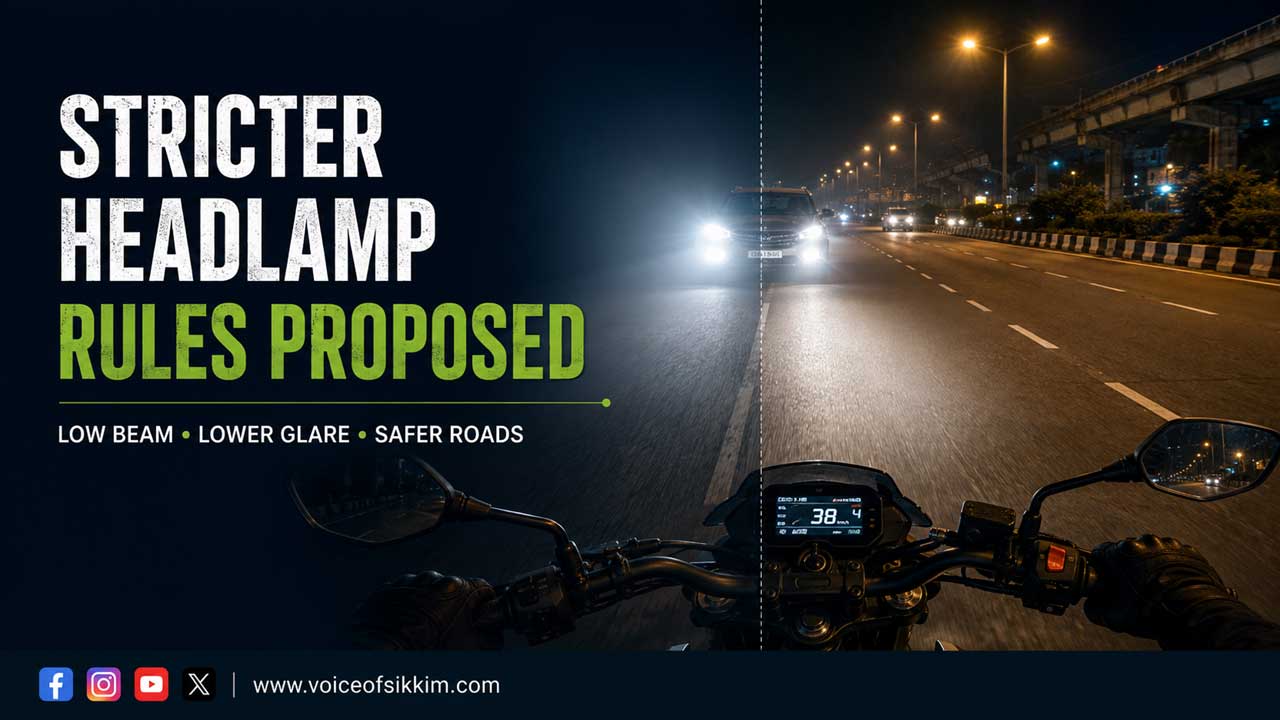
New Delhi, Aug 24 : Headlamp Rules proposed by the Ministry of Road Transport and Highways seek to introduce stricter vehicle-lighting standards to reduce glare and improve safety on Indian roads at night.
These measures are included in the draft amendments to the Central Motor Vehicles Rules and are anticipated to come into force from April 2027 following the completion of the regulatory process. The proposals include automatic headlamps for two-wheelers, restrictions on light intensity and colour temperature, reflective markings for heavy vehicles, and advanced lighting systems.
Automatic Headlamps Restricted to Low Beam
The Automatic Headlamp On feature on two-wheelers which have been newly manufactured will function only in the passing-beam mode, this being more commonly referred to as low-beam.
Currently, an AHO system can switch between low and high beam according to the vehicle’s settings, but the amendment will make sure that the automatic feature stays on low beam, even though riders will still have the option of switching to high beam when needed.
The requirement will be limited to new two-wheelers and will have no impact on vehicles that are already operating on the roads in India.
The ministry is said to have decided on carrying out regulatory changes since the campaigns which urged motorists to use the low beam did not achieve the desired outcome.
Headlamp Intensity Limits to Be Reduced
The draft rules suggest reducing the maximum allowed luminous intensity of high-intensity headlamps.
The limit for two-wheelers would be lowered from 1.5 lakh candela to 1 lakh candela, and for four-wheelers, covering passenger cars as well, the limit would be reduced from 2.25 lakh candela to 1.5 lakh candela.
Candela is the unit accepted for measuring the luminous intensity of a light source and the minimum levels are designed with the aim of reducing the effect of glare that drivers and riders have when approaching vehicles fitted with headlamps of excessive power.
Colour Temperature Capped at 6,500 Kelvin
The government has likewise suggested limiting the colour temperature of headlamps and front fog lamps to a maximum of 6,500 Kelvin.
The studies mentioned in the reports show that white light having a higher colour temperature causes more glare, which in turn leads to discomfort and reduces visibility for other road users.
The height at which the main-beam headlamps are mounted will also correspond to the height specified for the passing-beam lights.
High-Beam Audio Warning Under Consideration
New-generation vehicles could also be fitted with an audio warning system which responds to speed in order to discourage the unnecessary use of high beams in urban areas.
The system would be able to give an alert if the driver chose high beam while in a city driving situation, causing the beam to be switched back to low. However, the warning was said to stay off when the vehicle is moving at over 60 kmph on a highway, since high beam might be necessary on poorly lit sections.
The proposed alert has not still been confirmed as a final requirement and is still included in the reported safety framework.
Reflective Tapes for Heavy Vehicles
Buses and other heavy vehicles would have to be fitted with real reflective tape in order to make it easier to identify them at night and in conditions such as fog or rain or other situations involving low visibility.
The draft amendments also include updates to the standards for adaptive passing-beam and adaptive high-beam systems; these technologies adjust the distribution of light automatically in response to traffic and road conditions in order to improve visibility without causing excessive glare to motorists coming towards them.
The measures are meant to deal with one of India’s most enduring dangers when driving at night. When drivers use their high beams too much, this can temporarily interfere with the vision of a vehicle coming towards them, making it hard for them to spot pedestrians, judge distance or respond to obstacles.
The measures are still in draft form and it is therefore possible that their provisions and implementation schedule will be altered before the government publishes its final notice.