Twisha Sharma death case: Bar Council suspends husband Samarth Singh’s licence as CBI probe ordered, High Court directs second autopsy by AIIMS Delhi in the ongoing Twisha Sharma Death Case.
From love story on a dating app to a death that shook the nation — a comprehensive account of one of Madhya Pradesh’s most high-profile criminal cases
The Twisha Sharma Death Case has unfolded dramatically, capturing national attention and sparking discussions about domestic violence and justice.
Bhopal/New Delhi, May 23 : What began as a romance on a dating app in 2024 has unravelled into one of the most consequential criminal cases in Madhya Pradesh in recent memory — involving allegations of dowry harassment, a suspicious death, an absconding husband, a retired judge mother-in-law accused of evidence tampering, and now the intervention of the country’s highest legal regulatory body.

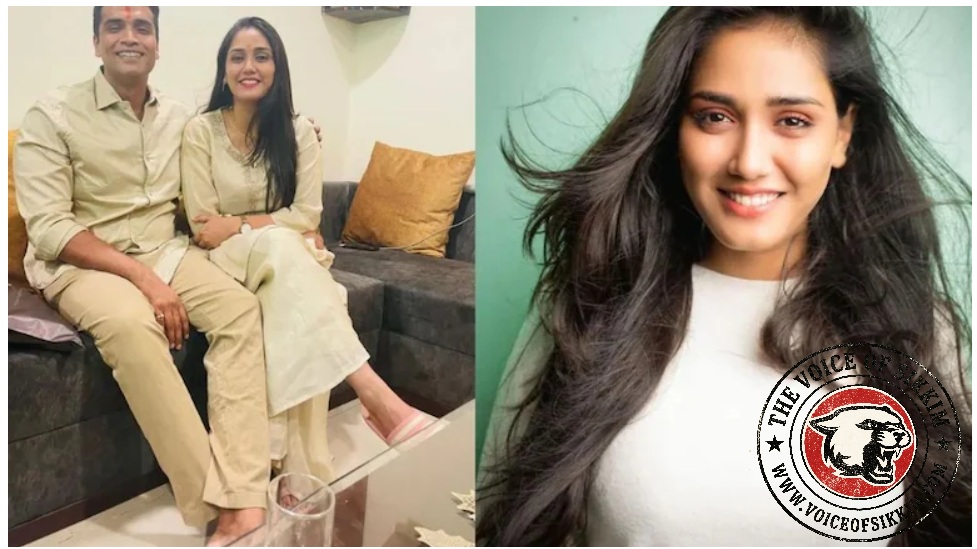
Twisha Sharma, 33, a former model and actress from Noida who had married Bhopal-based lawyer Samarth Singh just five months earlier, was found hanging at her matrimonial home in the Katara Hills area of Bhopal on the night of May 12, 2026. What the official post-mortem described as a hanging, her family described as something far more sinister — a death preceded by months of dowry demands, physical assault, and emotional cruelty. Ten days later, the case has drawn in the CBI, the Madhya Pradesh High Court, the National Commission for Women, the state’s Chief Minister, and now the Bar Council of India.
The marriage and the death
In the Twisha Sharma Death Case, the complexities surrounding her marriage and tragic demise have revealed the dark underbelly of societal pressures.
Twisha Sharma met Samarth Singh, a practising advocate in Bhopal, on a dating application in 2024. The couple married in December 2025. Samarth’s mother, Giribala Singh, is a retired district judge who at the time of Twisha’s death was serving as Chairperson of the Bhopal District Consumer Commission — a position that would later become a focal point of the controversy.
On the night of May 12, 2026, Twisha was found hanging inside the couple’s home in Katara Hills. The official post-mortem report cited hanging as the cause of death. Her family, however, disputed this conclusion from the outset, pointing to multiple injury marks on her body that they alleged were not adequately examined or explained in the initial forensic report. The family further alleged that Twisha had been subjected to continuous dowry demands and physical assault after her marriage, and that she had been forced to terminate a pregnancy after her husband publicly questioned the paternity of the child.
An FIR was registered against Samarth Singh and his mother Giribala Singh under charges of dowry death and cruelty. Samarth Singh absconded immediately following Twisha’s death and remained missing for ten days.
Public outrage and institutional intervention
Public protests and demands for justice have intensified regarding the Twisha Sharma Death Case, reflecting a broader call for change.
As news of the case spread nationally, public outrage mounted rapidly. The National Commission for Women stepped in, demanding a thorough and independent investigation. The family’s allegations took on added weight given Giribala Singh’s background as a retired judge — raising concerns in public discourse about whether judicial connections were being used to shield the accused and influence the investigation.
The Twisha Sharma Death Case highlights critical issues regarding the treatment of women and the social stigmas they face.
The family alleged specifically that Giribala Singh had misused her influence to tamper with a final video of Twisha that had been widely circulated on social media, claiming the timestamp on the footage had been manipulated. Bhopal Police, meanwhile, issued a cash reward of Rs 10,000 for information leading to Samarth Singh’s whereabouts.
Court rejects second autopsy; family mounts legal pressure
As the legal proceedings in the Twisha Sharma Death Case progress, advocates for women’s rights are watching closely.
On May 20, a Bhopal court rejected the family’s plea for a second post-mortem examination to be conducted at AIIMS Delhi, dealing an initial setback to the family’s demand for independent forensic scrutiny. Bhopal Police separately urged the family to claim Twisha’s body from AIIMS Bhopal, citing concerns over decomposition. The family resisted, determined to wait for an independent examination.
By May 21, events began accelerating. Bhopal Police raised the cash reward for information on Samarth’s whereabouts to Rs 30,000. Proceedings were formally initiated to remove Giribala Singh from her chairperson post at the Bhopal District Consumer Commission, and the MP Police issued what it described as a “third and final notice” to the retired judge. The state government simultaneously sought clarification from the State Consumer Disputes Redressal Commission on whether Giribala Singh could legally continue in her institutional role while under active criminal investigation.
On the legal front, family lawyer Ankur Pandey announced that the family would approach the principal bench of the Jabalpur High Court to challenge Giribala Singh’s anticipatory bail. The family’s legal team argued that the subordinate court had ignored material evidence and failed to apply the legal presumption in dowry death cases as required under Section 118 of the Bharatiya Sakshya Adhiniyam 2023. Twisha’s father, Navnidhi Sharma, separately filed a petition at the MP High Court seeking the immediate revocation of Giribala Singh’s bail.
The surrender that wasn’t — and the arrest that was
On May 22, ten days after Twisha’s death, Samarth Singh appeared before the District Court in Jabalpur — arriving, according to reports, wearing a mask and cap — in an apparent bid to surrender. The move was immediately rejected as jurisdictionally invalid. The divisional judge directed him to surrender before the trial court or the investigating officer in Bhopal, the seat of the original jurisdiction. Samarth had also, through his counsel, informed the Madhya Pradesh High Court that he wished to withdraw his anticipatory bail application. He was subsequently taken into custody by Bhopal Police from the premises of the Jabalpur court.

The family’s legal team was scathing. Advocate Anurag Srivastav, representing Twisha’s family, told reporters that the Jabalpur appearance was a deliberate jurisdictional manoeuvre. “The court has ordered that Samarth Singh either surrender before the trial court or the investigating officer. The trial court is in Bhopal. Look at how the son of a retired judge is being protected. He has no authority to surrender in the District Court, Jabalpur,” he said. Srivastav alleged that Samarth’s status as the son of a retired judge was affording him a level of legal protection unavailable to ordinary citizens.
On the same day, the Madhya Pradesh government formally recommended a CBI probe into Twisha’s death. The official notification, signed by Home Department Secretary Krishnaveni Deshavatu, was dispatched to top central and state authorities for the immediate transfer of case files. The decision followed a direct meeting between Twisha’s father and Chief Minister Mohan Yadav, who agreed to the family’s appeal for a fair and independent investigation.
The government’s recommendation for a CBI investigation into the Twisha Sharma Death Case signifies a critical step towards transparency.
Bar Council strips Samarth of his legal licence
The Bar Council’s swift action against Samarth Singh in the Twisha Sharma Death Case sets a precedent for accountability in the legal field.
In one of the most significant institutional responses to the case, the Bar Council of India on May 22 suspended Samarth Singh’s licence to practise law with immediate effect. The order was issued by BCI Chairman Manan Kumar Mishra, who left little ambiguity about the body’s assessment of the case.
“Shri Samarth Singh, Advocate, is hereby suspended from practice as an advocate with immediate effect, pending further consideration,” Mishra stated officially. Speaking separately to IANS, he went further: “Her husband Samarth Singh has a role in her murder. This is proved in investigation prima facie. There are allegations and, on top of that, he was also not cooperating in the investigation and was absconding.”
The BCI noted that the allegations against Samarth were “grave and affect the dignity and public image of the legal profession,” and that his alleged absconding and non-cooperation with investigators had made urgent interim action necessary. During the period of suspension, Samarth is barred from appearing, acting, pleading, practising, or filing vakalatnamas before any court, tribunal, authority, or forum in India. The matter has been referred to the appropriate BCI Disciplinary Committee for further orders. The BCI clarified the suspension is without prejudice to the ongoing criminal trial or any legal defence available to the accused.
High Court orders AIIMS autopsy; body to be preserved
The High Court’s order for a second autopsy in the Twisha Sharma Death Case has renewed hope for her family seeking justice.
In the latest and most consequential judicial development, the Madhya Pradesh High Court on May 23 ordered a second autopsy of Twisha Sharma’s body to be conducted by a specialist team of doctors from AIIMS Delhi. The court directed that the AIIMS doctors travel to Bhopal via a special flight to perform the examination there. The court simultaneously directed authorities to preserve Twisha’s body at ultra-low temperatures to safeguard forensic integrity ahead of the second post-mortem — overturning, in effect, the pressure that had been placed on the family to release the body.
The High Court’s order marks a significant vindication for Twisha’s family, who had been fighting since her death for an independent forensic examination. The case now awaits the AIIMS team’s findings, the CBI’s formal takeover of the investigation, and further legal proceedings against both Samarth Singh and his mother Giribala Singh.
The Twisha Sharma Death Case underscores the importance of rigorous forensic investigations in cases of suspicious deaths.
CASE AT A GLANCE
December 2025 — Twisha Sharma and Samarth Singh marry in Bhopal
The timeline of events in the Twisha Sharma Death Case is crucial to understanding the gravity of the situation.
May 12, 2026 — Twisha found hanging at her matrimonial home in Katara Hills, Bhopal; FIR filed; Samarth absconds
May 20, 2026 — Bhopal court rejects family’s plea for second post-mortem
May 21, 2026 — Police reward raised to Rs 30,000; proceedings initiated against Giribala Singh; family moves High Court to revoke her bail
May 22, 2026 — Samarth appears at Jabalpur court; surrender rejected as invalid; arrested by Bhopal Police; MP government recommends CBI probe; Bar Council of India suspends Samarth’s advocate licence with immediate effect
May 23, 2026 — MP High Court orders second autopsy by AIIMS Delhi; body to be preserved at ultra-low temperatures; Samarth in Bhopal Police custody
Explosive new witness: Salon owner reveals Twisha’s final hours and mystery visitors who seized CCTV footage
A major new dimension has emerged in the case following the testimony of Kiran Parihar, owner of a beauty parlour in Bhopal that Twisha Sharma visited on the very day she died. According to NDTV , CCTV footage from the salon has confirmed that Twisha spent nearly three hours at the parlour on May 12 — the day of her death — availing a head massage and pedicure. She left the premises at approximately 6:15 pm. She was found hanging at her matrimonial home in Katara Hills later that same evening.

What happened the following morning has raised the most serious questions yet about the conduct of Giribala Singh in the hours immediately after her daughter-in-law’s death. According to Kiran Parihar, Giribala Singh — a retired district judge — began calling her repeatedly at around 11:35 am on May 13. Giribala sought specific details of Twisha’s last visit to the salon, including the services she availed and the payment and bill records. She then asked for the CCTV footage of Twisha’s visit. When Kiran Parihar asked whether Twisha was alright, Giribala informed her that Twisha had died by suicide — notably framing the death as suicide from the very first external contact she made.
Shortly after these calls, a group of five or six individuals dressed as lawyers arrived at the salon in person. A woman among the group identified herself as an advocate and told the salon owner that the police required the CCTV footage. The group physically removed the recording from the salon premises and left. The real identities of these individuals remain unknown to date, and it has not been verified whether they were genuine advocates or whether any police authority actually authorised or requested the footage retrieval.
The salon owner added that she had known Twisha since her wedding reception, and that both Twisha and Giribala Singh had been regular clients at the parlour. The testimony directly corroborates the family’s longstanding allegation that Giribala Singh was engaged in coordinated evidence gathering — and potentially evidence suppression — within hours of Twisha’s death, well before investigators could independently secure the material.
High Court orders AIIMS Delhi team to Bhopal; body to be preserved at ultra-low temperatures
In the most consequential judicial intervention in the case so far, the Madhya Pradesh High Court on May 23 ordered a second autopsy of Twisha Sharma’s body to be conducted by a specialist medical team from AIIMS Delhi. Crucially, the court directed that the AIIMS doctors travel to Bhopal via a special flight to perform the examination there — ensuring the body does not need to be transported and that forensic integrity is maintained.
The court simultaneously directed authorities to preserve Twisha’s body at ultra-low temperatures ahead of the second post-mortem. The directive effectively overturns the pressure that had previously been placed on the family by Bhopal Police to release the body, and marks a significant judicial endorsement of the family’s demand for an independent forensic examination — a demand that had earlier been dismissed by a lower Bhopal court on May 20.
The findings of the AIIMS Delhi team are expected to be the most critical piece of forensic evidence in determining the true cause of Twisha Sharma’s death, and are being awaited closely by investigators, the family, and the public alike.
Twisha Sharma’s death case: Husband Samarth Singh sent on 7-day police remand
The Twisha Sharma death case took a new turn after her husband, Samarth Singh, turned himself in at a Jabalpur court. Scenes inside the court got pretty chaotic, with confusion and crowds gathering after his surrender.
By early morning, police brought Singh to Bhopal, where a local court ordered him into police custody for the next seven days. While he’s being held, officers have seized his passport to keep him from leaving the country.
Samarth Singh isn’t just anyone—he’s the son of Giribala Singh, a former judge and currently the chairperson of the Bhopal Consumer Court. Investigators say they plan to ramp up their questioning as this high-profile case keeps grabbing headlines and the public’s attention.
The developments in the Twisha Sharma Death Case are significant not only for the family but also for society’s approach to domestic issues.
Supreme Court to hear Twisha Sharma dowry death case on Monday amid questions over probe irregularities
The Supreme Court has taken notice of the death case of model-turned-actor Twisha Sharma. She was found dead at her matrimonial home in Bhopal last week. The court will hear the matter on May 25, which falls on a Monday.
A bench that includes Chief Justice Surya Kant, Justice Joymalya Bagchi, and Justice Vipul M Pancholi will hear the case.
It is listed under the title: “Alleged institutional bias and procedural discrepancies in the unnatural death of a young girl at her matrimonial home.”
Previously, Twisha Sharma’s husband, Samarth Singh, was placed in police custody for seven days after he surrendered at a Jabalpur court in connection with the case.
May 24, 2026
Twisha Sharma cremated after second autopsy by AIIMS Delhi team on High Court’s orders
Madhya Pradesh saw emotional scenes on Sunday as the body of former model-turned-actor Twisha Sharma was returned to her family after a second autopsy by a team of doctors from AIIMS Delhi. This followed an order from the High Court.
Twisha’s body was transported from AIIMS Bhopal to the Bhadbhada Vishram Ghat for her last rites, 12 days after she was found hanging at her home in Bhopal’s Katara Hills area on May 12. Family members gathered outside the mortuary while the post-mortem procedures were completed. Many relatives were in tears, while doctors and family members remained inside for the handover of the body.
“The family has decided that Twisha’s cremation will take place today,” her brother Harshit Sharma confirmed earlier in the day.
Second autopsy after High Court order
A four-member team of senior doctors from AIIMS Delhi arrived in Bhopal on Saturday night and started the second post-mortem at AIIMS Bhopal on Sunday morning, as ordered by the Madhya Pradesh High Court on May 22.
Advocate Ankur Pandey, who was with the family’s technical team, said the examination began after Twisha’s brother and sister-in-law identified the body. “The autopsy was completed by 3:40 PM,” he told PTI.
May 25, 2026 – “Better a Divorced Daughter Than a Dead One”: SG Tushar Mehta’s Emotional Remark in Twisha Sharma Death Case

The Supreme Court heard the suo motu case related to the death of former actor-model Twisha Sharma on Monday. Solicitor General Tushar Mehta made a strong observation that quickly drew public attention.
The remarks made during the Supreme Court hearing reflect the societal implications tied to the Twisha Sharma Death Case.
Representing the Madhya Pradesh government, SG Mehta told the apex court that parents must face a painful truth: “It is better to have a divorced daughter than a dead one.”
He expressed sadness over the 33-year-old’s death and the alleged cruelty she faced in her marriage. Mehta noted how the case reflected the emotional pain Sharma reportedly endured. Referring to messages Twisha allegedly sent, he revealed that she described her life as “hell.”
“One thing is clear; that girl has lost her life. Whether it is suicide or something else, the lesson for parents is that it’s better to have a divorced daughter than a dead one,” Mehta stated before the bench.
During the hearing, the Madhya Pradesh government informed the court that the Central Bureau of Investigation (CBI) is expected to take over the probe within a day. The state has already written to the Centre to recommend a CBI investigation into this high-profile case.
The attention surrounding the Twisha Sharma Death Case is indicative of a growing demand for justice and reform.
A bench led by Chief Justice of India Surya Kant urged both families and the media to avoid making statements that could interfere with the investigation. The court warned against creating narratives around the case and emphasized the need for a fair and unbiased probe.
“We trust our state agencies and the CBI. However, a certain narrative is being formed. We will make sure this unfortunate incident is investigated fairly,” the Chief Justice commented.
The Supreme Court’s attention to the Twisha Sharma Death Case indicates a commitment to ensuring justice.
The Supreme Court further asked the media not to record statements from people who could later be witnesses in the case. It advised Twisha Sharma’s family to share their concerns directly with the investigating agency rather than speaking publicly.
The suo motu proceedings began after allegations arose about bias and irregularities in the investigation. Senior advocate Siddharth Luthra, representing the deceased woman’s side, raised concerns about delays in filing the FIR and other issues in the probe.
The scrutiny of the Twisha Sharma Death Case raises critical questions about how the legal system handles domestic violence.
The apex court also expressed discomfort over claims suggesting that the judiciary was protecting the accused, particularly since the case involves a former district judge and a lawyer. Calling the incident unfortunate, the bench called for restraint and responsible reporting while the investigation continues.
Media coverage of the Twisha Sharma Death Case is crucial in maintaining public awareness and pushing for accountability.
A senior doctor from AIIMS Bhopal confirmed that the examination was done strictly according to the High Court’s instructions.
This is a developing story. Updates will be incorporated as the investigation progresses.
As the Twisha Sharma Death Case develops, it serves as a reminder of the need for ongoing dialogue about women’s rights.