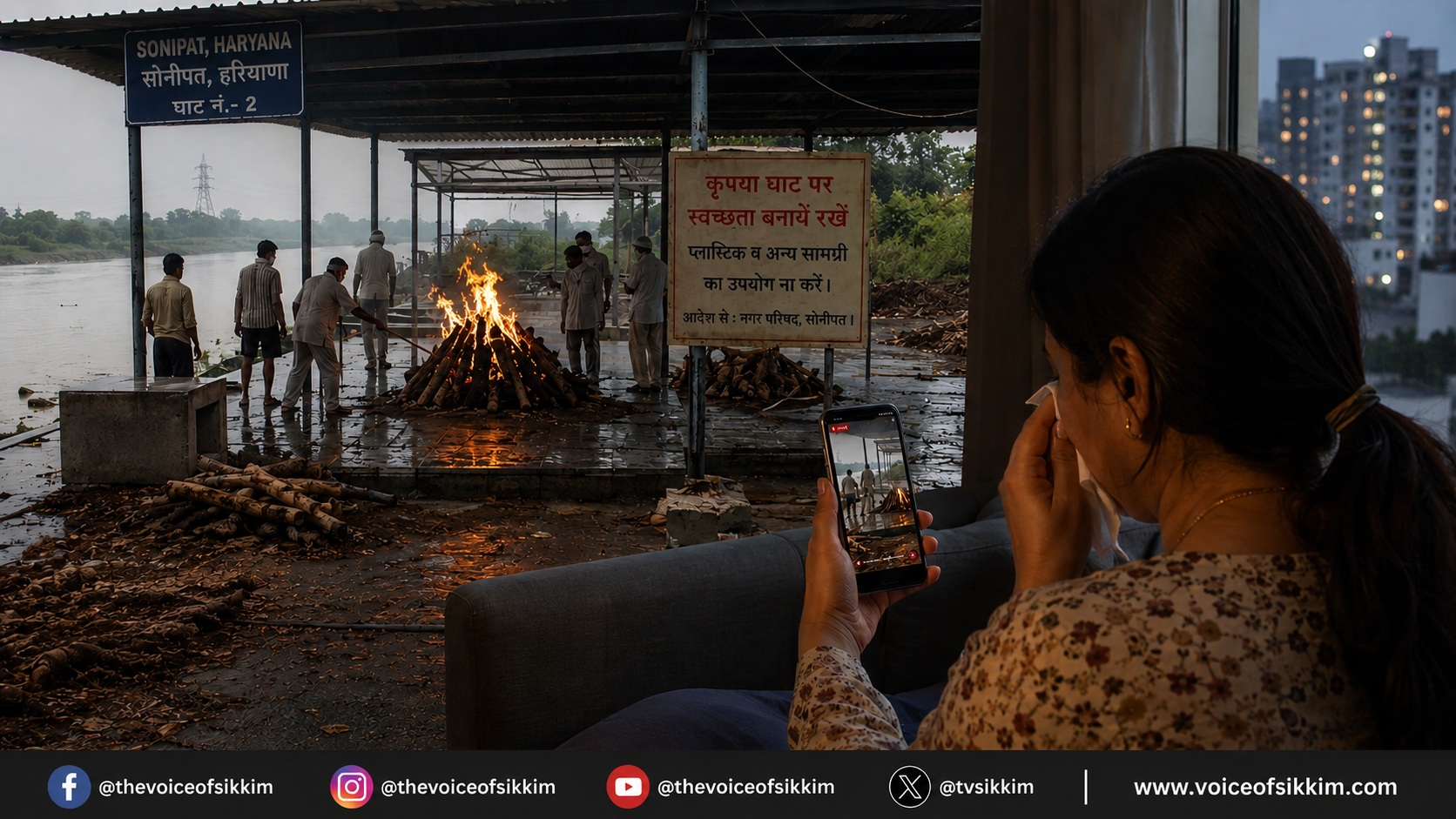

Sonipat, August 6. In a quiet corner of an old-age home in Sonipat, Haryana, an elderly man was laid to rest this week. There was no crowd of grieving family, no daughters holding each other as the fire was lit, and no hands reaching out to touch his forehead one last time. Instead, three phones lit up in three different corners of India and Nepal. Through small glowing screens, his daughters watched their father leave the world.
His name was Shivcharan Ram Ratan Gupta. He was once a textile trader in Mumbai, a man who built a life, raised three daughters, and spent his final year and a half in a home meant for those with nowhere else to go. He came here after his wife, Meena, passed away, carrying a phone that was, for a long time, his only link to his children.
He called them often. He asked about their lives, listened to their voices, and held on to whatever closeness a phone call could offer. But as his health began to fail, even those calls became less frequent. Twenty days before he died, the old-age home warned his daughters that his condition was serious. None of them came.
Gupta passed away early Tuesday morning, around 3:30 AM, after a long illness quietly wore him down. The home called his daughters again—Anita, the eldest, a teacher in Nepal; Nisha, living in Azamgarh, Uttar Pradesh; and Priya, the youngest, still in Mumbai, the city her father once called home. All three, now married with families of their own, were told they could still come and that there was time to say goodbye in person.
They said they couldn’t. Not enough time, they said.
So the funeral happened without them. It was arranged by the staff of the old-age home and the kindness of local residents who stepped in as family. Somewhere far away, three daughters watched through a video call, present only in pixels, as strangers lit the fire that would carry their father onward.
Anita sent ₹5,100 online, asking that her father be given a dignified farewell. It was a gesture—payment standing in for the presence that money can never replace.
In a moment that has since traveled across social media, breaking hearts and stirring anger, one of the daughters was heard on the call asking how much longer the rites would take. “We have to eat and bathe,” she said.
In that sentence lies the quiet tragedy of many aging parents in India today—a father who spent a lifetime giving, reduced in his final moments to an item on someone else’s schedule.
After the cremation, the daughters asked the home to send them videos, as if the ceremony could be relived later, replayed on a screen just like it had been watched. They asked that his ashes be immersed in the Ganga on their behalf. They could not come for that either. In his final act of giving, in keeping with the family’s wishes, Gupta’s eyes were donated after his death, so that somewhere, someone else would see the world he was leaving behind.
There was no crowd. No daughters standing by the pyre. Just a phone, a video call, and an old man who waited a year and a half in a home for the elderly, perhaps hoping that someone would come before it was too late.
Nobody did.